|
Thesis Statement
Urbanization describes the growth of the urban area while biodiversity describes the diversity of life from genes to ecosystems and spans every level of biological organization. Urbanization is a rapid modern phenomenon among all the developing countries. However, as the increase of urbanization, biodiversity is decreasing. Ecosystem of the nature is destroying by human beings since construction and devlopment of urban cities always have a great impact upon habitats and vulnerable species that they contains. Urban ecology focuses on the coupled relationships between humans and nature and aims to how human and ecological processes can coexist in human-dominated systems and help acheiving a more sustainable society. Therefore, as disconnection between human and nature is formed, failure of urban ecology becomes a big concern in these recent years.

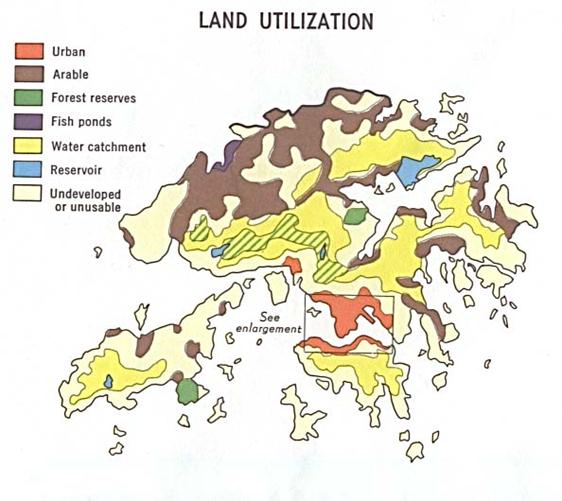
Hong Kong is a linear city which most of the urban fabric are built along the Victoria Harbour on Hong Kong Island and Kowloon Peninsula. Hong Kong is a typical city of rapid urbanization development. At the same time, Hong Kong is home to high biodiversity because of its sub-tropical climate and natural habitats ranging from sea, through mangroves and mudflats to rivers, forests and hills. There are over 3000 species of flowering plants, over 300 tree species, more than 230 species of butterflies and just over 500 bird species in Hong Kong. However, what we can observe now in Hong Kong is that the nature and the urban are actually disconnected. Although Hong Kong is a city of high diversity, the urban ecology is still a failure.
Therefore, the objective of this thesis is to find out the connection between nature, cities and architecture and to test the possibility of human and nature interface in Hong Kong based on multi-species habitats. The expectation of this thesis is to prove the possibility of urban ecology in Hong Kong which can maintain biodiversity and at the same time undergo urbanization.
 Description of Project Intended to Test the Thesis Statement Description of Project Intended to Test the Thesis Statement
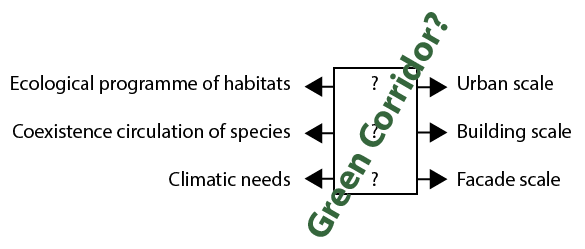
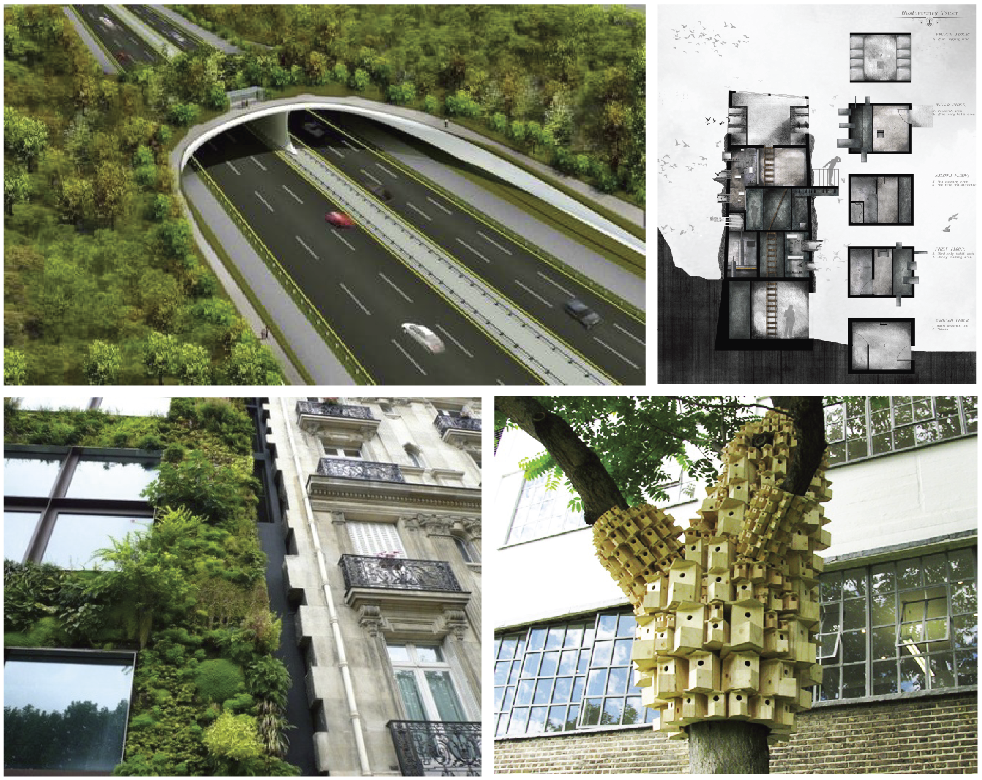
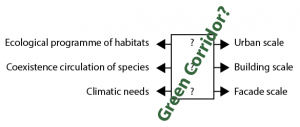
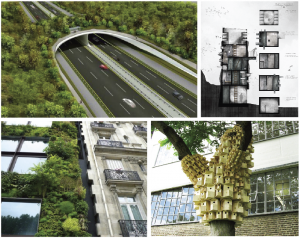
This project is about the connection between nature, cities and architecture. In Hong Kong, these three aspects are likely in a parallel situation. To intersect these aspects, architecture becomes a tool to engage nature and cities. The study of the connection can be of different aspects – ecological programme of habitats, coexistence circulation of species, climatic needs; in different scales – urban scale, building scale and facade scale.
  Methodological Processes/ Outline of Research/ Design Experiments Methodological Processes/ Outline of Research/ Design Experiments
1. Studying ideas of urbanization, biodiversity and urban ecology
2. Studying Hong Kong urban and nature situation
3. Urban Scale: Mapping the different possibilities of migration corridors in Hong Kong
based on species
4. Building Scale: Experimenting structures, circulation systems and ecological
programs to fufill the needs or habitats among different species
5. Facade Scale: Experimenting facade technologies to deal with climatic needs of different
species
Bibliography:
1. Urban Ecology : An International Perspective on the Interaction Between Humans and
Nature, Marzluff, J., Shulenberger, E., Endlicher, W., Alberti, m., Bradley, G., Ryan, C.,
ZumBrunnen, C., Simon, U. (Eds.), 2008, XXVI, 808p. 149 illus.
2. Toward A Multicultural Ecology, Adrian Ivakhiv, University of Wisconsin-Oshkosh,
Organization & Environment, Vol. 15 No. 4, December 2002 389-409
3. Architecure and Deep Ecology, Arne Naess, The Trumpeter, Vol. 21 No.2, 2005
|