City As A Mnemonic Device
|
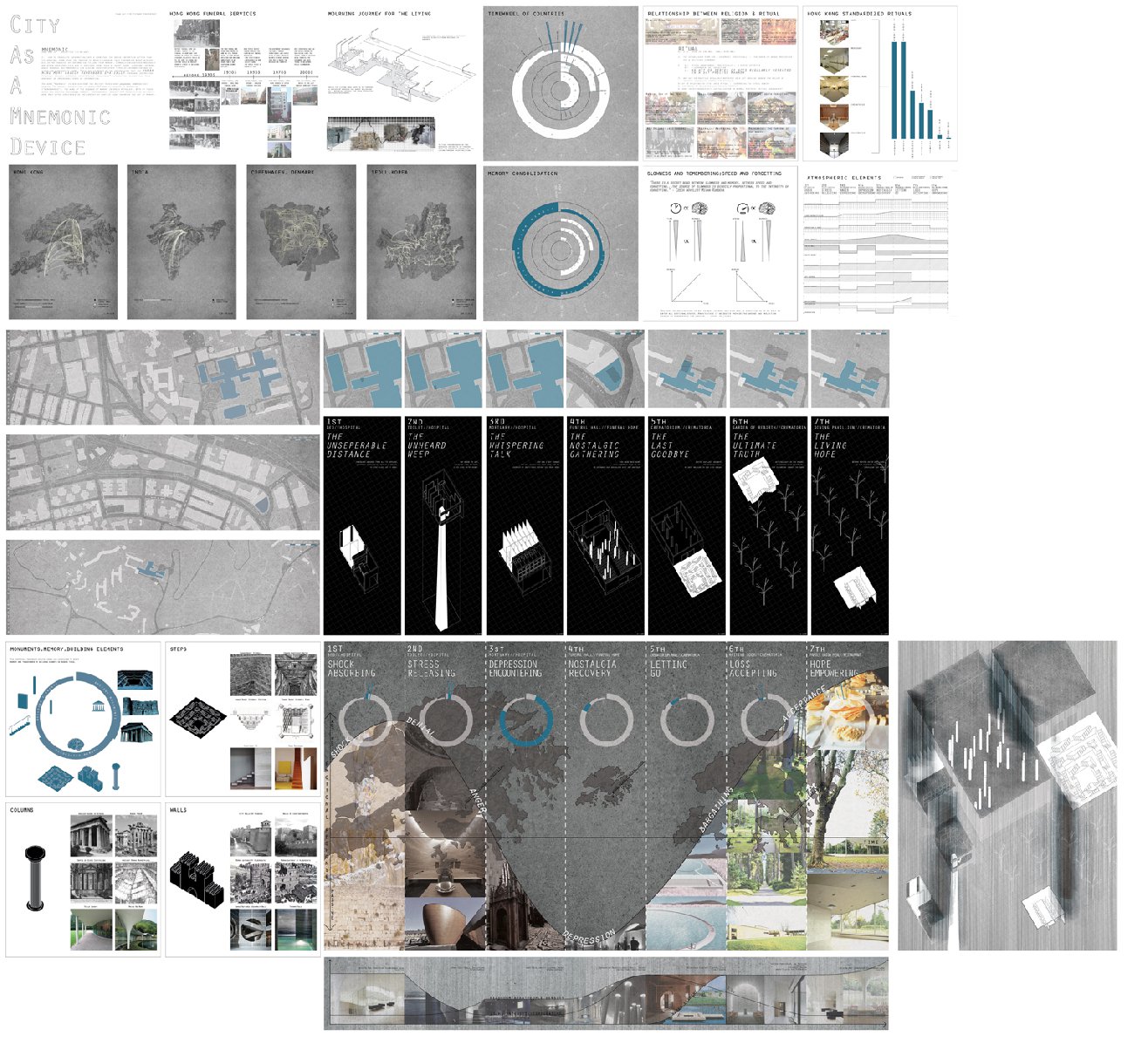
What? Hong Kong has long been troubled with the problem of after-death infrastructure, not only the supply of columbarium is not matching with the growing demand, but the most severe problem is the segregation of after-death services being dispersed in different locations and segregated ownership of different parties, both privately owned and governmental, has caused a loose system of handling after-death procedures. The phenomenon of the scattered infrastructures was highly due to the denial of general public to coexist with them due to cultural and ritual reasons. “The question of the fragment in architecture is very important since it may be that only ruins express a fact completely… I am thinking of a unity, or a system, made solely by reassembled fragments,” suggested by Aldo Rossi, this thesis hope to tackle this phenomenon in three scales: urban, building and culture, and establish a new typology for a better system of after-death services. The after-death services infrastructures are being marginalized to the edge of the urban context; the cremation process is being marginalized as a back of house program within the architecture; and culturally people refuse to coexist with these infrastructures. Through testing two prepositions of locating a crematorium within an urban context and the appropriateness of standard crematoria design, I wish that through architecture to engender death as something to be celebrated and affirmed rather than denied. Why? The Hong Kong government has a future plan of securing steady supply of new niches by proposing all 18 districts to have their own plot for building columbarium, yet the public has showed strong opposition to the idea of placing columbarium in the urban context. The thesis hope to set up a new typology that could engage the highly-dense city community in Hong Kong, as a testing ground, to solve this urbanistic issue of community’s refusal to coexist with these facilities. Urban integration should be experimented for future development in Hong Kong of the urgent need of raising niche capacity. Not only in the scale of urban context, but also down to the linear process of death that should not be segregated location wise and within the crematorium. Death should be treated as a process for not only the deceased to go through but also the living, to be celebrated but not denied. To celebrate the death as life, the linearity of the cremation process must not be minimized as a back of house program within a piece of architecture, but to be experienced together with the living as part of the mourning journey. How? I would like to start by looking into Georges Bataille writing on slaughterhouse, that “is cursed and quarantined like a plague-ridden ship”, which have a similar nature of denial as crematorium in Hong Kong that has turned into a mechanical and technical activity being alienated, yet in the Parc de la Villette project, once the biggest slaughterhouse in France, turned into a museum that public has forgotten the history of it. Hollier has written, “The slaughterhouses are the negative pole, the generator of repulsion, the centrifuge… It is not about designing for the dead, but for the living, for death is inextricably part of life, as coexistence with the after-death urban infrastructures should be explored for the prudent planning in Hong Kong to ensure its capacity for the indefinite future, and the linear cremation process in architectonic expression to be made complete psychological journey of mourners. |