Why
As “ Ageing population’ is a pervasive, profound and enduring tide sweeping across the globe, Hong Kong is no exception. Large foreign workers are coming to balance this aging ratio which cause the urban congestion issue even more severe than it was before. Urban space of Hong Kong is lacking of breathing space due to these diversity of people, where people just rushing all the time during travelling, no time to stop for resting or even just get a feel of time passing. Urban dwellers living in such a fast changing city are restless to think, to manifest, or contemplation where they will be or what the future will become. In order to balance this city of chaos, restlessness, burst, I would like to insert healing place in urban city to balance people with a healthier psychological feeling of the city, as well as to vision, to think for the future of the space. I would like to engage ‘time’ as important dimension towards architectural design.
“Gebser observes that ‘time’ as a world constituent and perceived reality emerged from Einstein’s theories on four- dimensional space- time continuums. The new consciousness became the setting for the spiritual transparency, diaphanousness, in which insight will replace knowing. It is understood through ‘etiology’, which cant be explained by philosophy. Time as non-spatial character couldn’t become part of the classified systems. This all integrating medium will be the catalyst to materialize and solidify spatial consciousness.”
What
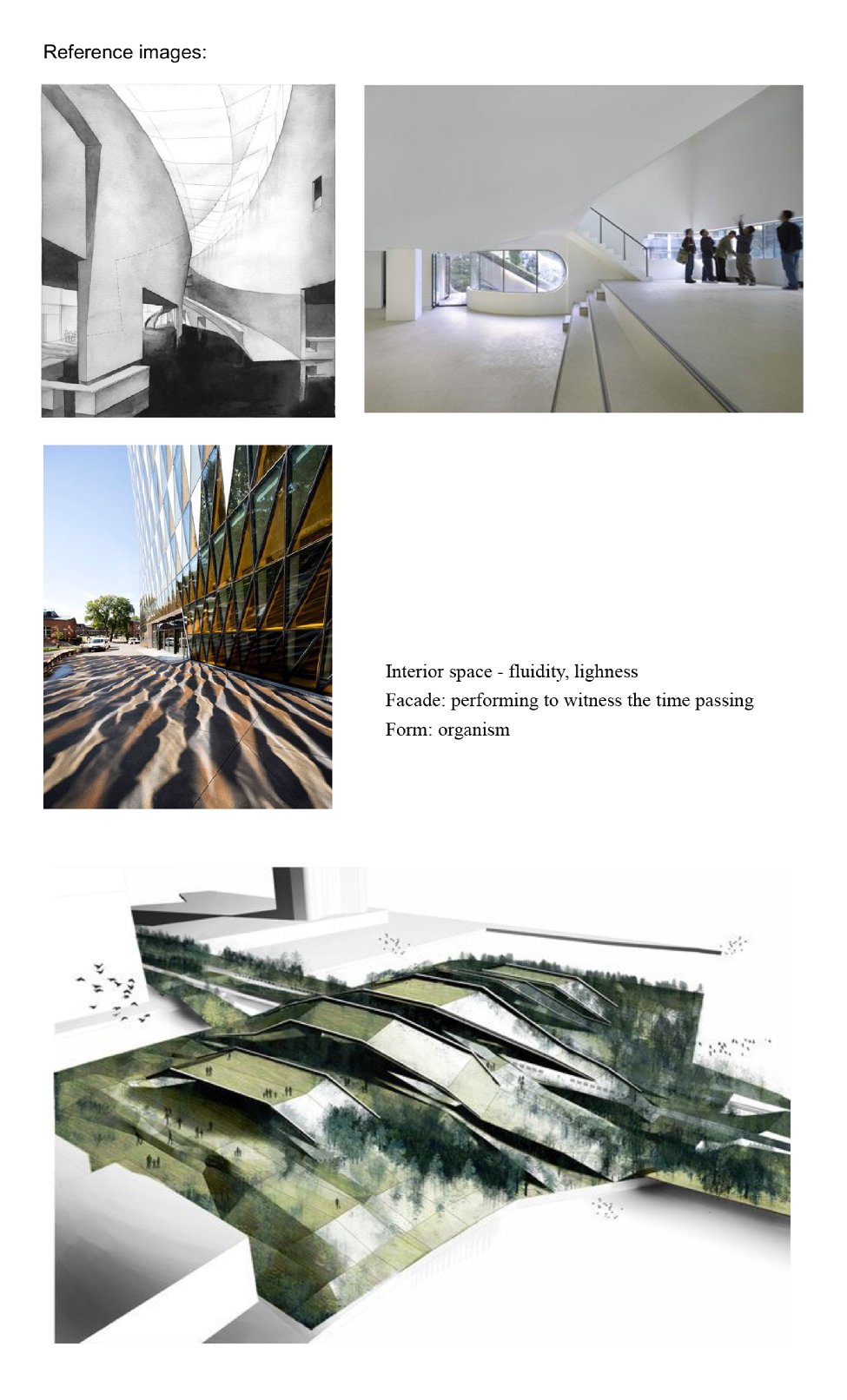
The healing space served as a public space for city dwellers, where they could capture the time physically through journey of the architecture. In terms of design, I would like to adopt and apply Einstein’s theorem – physiogemetrical in nature, which based on his first theory as relativity, introducing time as 4th dimension. As refer to an invisible phenomena, which were felt but not captured, as the action or labour factor. If one define action by energy, one would obtain a time-relation equation. This new consciousness of time as mentioned by Gebser[ Gans, Deborah, and Zehra Kuz. 2003. The organic approach to architecture.] became the setting for the spiritual transparency in which insight will replace knowing. However, to capture the time, which is moving nonstop, we need to compare and contrast something which is fixed such as space frame. For instance, Frank Lloyd Wright’s description of the new architecture in which the measuring unit of time has become a new measuring unit of space , where all fixed relationship are replaced by flexible ones. The time factor as movement dissovles the rigid space into a fluid one, turning it into a space-time continumm. Like music hall in symmetrical geometry form, conceived as deviation from rigid order, emphasize on the central focal point, deflect and dispersing the sound reflection. The time is passing through the moving and static medium. The sound is moving media, while the space is static.
How
1. Performance In order to design space with the fourth dimension – time in spatially, I would like to engage with contemporary techniques for design methodology: It is temporal, process driven methods that provide new trans-formative effects in cultural, social and political production.Living as a changing process, no static state, it runs according to the life-effecting secret energies of the spiritual world. Here the architecture function as medium with technical performance, influenced and modified by human behavior. The path of evolution produced by a cultural entity- an object, a building immersed in its context.[ Rahim, Ali. 2002. Contemporary techniques in architecture.] The building also witness the cultural transformation through a complex system of evolution.
2.Organism I would also like to apply the method of nature- as form (organic and mathmetical approach to shape of building.) Mentioned by Haring[ Gans, Deborah, and Zehra Kuz. 2003. The organic approach to architecture. ] that the culture of architecture evolved from a pregeometric to geometric and finally to organic phase. Geometric era was coming to a close and the future had a chance to pursue the organic approach – finding analog to nature. Thus, organic approach to architecture could perform as adaption to the immediate environment to witness the transformation of city, as well as the moving medium.
3.Light and movement The movement of lighting effect can also served as a moving medium to capture time in space. Directional circulation movement will be applied to creating a place of sacredness to manifest and contemplate their vision and future in their limited lifetime. This healing place not only to create a leisure park for urban dweller also reconnect with the fast growing world through the new medium of design and social connection.
Bibliography:
Gans, Deborah, and Zehra Kuz. 2003. The organic approach to architecture. Chichester [England]: Wiley-Academy.
Rahim, Ali. 2002. Contemporary techniques in architecture. London: Wiley-Academy.
Turnbuall,J. 2009. Toyo Ito Forces of nature. New York : Princeton Architecture press
Day, C. 2004. Places of the soul: Architecture and environmental design as a healing art. UK: Martins the Printers
Smith, Peter F. 1977. The syntax of cities. London: Hutchinson.