|
|

WHY
Shopping malls basically are separated into 2 main groups; one is by private sectors, another is by the Government.
For private ones, because of the economy-driven design, malls are celebrating consumerism and luxurious lifestyle and shops are selling similar things all the time. Therefore the outcome is that many shops are selling something properly not related to the urban or the district needs. Private malls are privatized-public space, which is not exactly public realm, once it is closed, nobody can get in and it is just a box occupying so much lands, but for nothing.
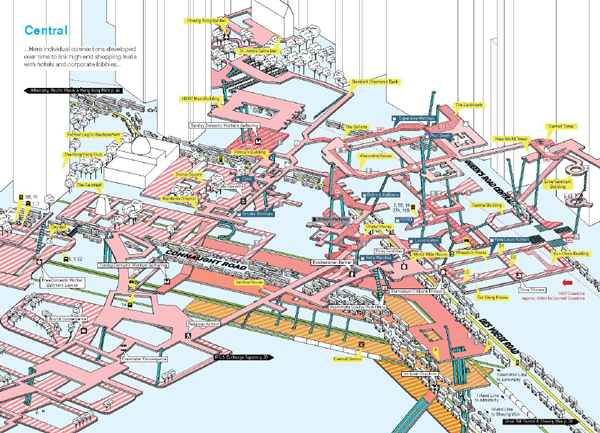
Also, Private malls are continuously expanding their network, different malls are connecting together and form a huge network, so called “city without ground” is formed then. And this is always an enclosed and internalized space which is totally isolated from the outside and it makes life become homogenized. But the fact is that Hong Kong is a consumerism country. Shopping malls become the main role here and they got the help from the Government in terms of the urban planning and more convenient transportation and pedestrian network, so it results in wasting public space for economic growth. As well as, Duplicating malls to everywhere in Hong Kong. It would dilute the identity of districts.
On the contrary, the Government’s malls are much better developed which are based on the needs of districts, and there are more social space for the urban relatively.
WHAT
Testing out the feasibility of shopping mall as a catalyst in urban planning, a new typology of mall. Public space reclaimed from shopping mall. Re-programming of shopping malls in order to benefit to the society as well.
HOW
To Analysis of every single shopping mall in Hong Kong and research on the needs of a district in order to find out the characteristic which will be brought into the mall later. As well as the relationship between malls and circulation that is the clue to figure out the public and private realm.
BIBLIOGRAPHY:
- Jane, J. (1970), The Economy of Cities, Vintage Books, A Division of Random House, New York
- Jane, J. (1985),Cities and The Wealth of Nations, Vintage Books, A Division of Random House, New York
- Jane, J. (1992), The Death and Life of Great American Cities, Vintage Books, A Division of Random House, New York
- Adam, F., Jonathan, D.S. & Wong, C. (2012),Cities Without Ground: A Hong Kong Guidebook, ORO editions, USA
- Winy, M., Tihamer, S. & Bas, K. (2011), Hong Kong Fantasies: Challenging World-Class City Standards, The Why Factory and NAi Publishers, Belgium
- Montgomery, C. (2013), Happy City: Transforming Our Lives Through Urban Design, Penguin Books, England
- Esther, L. & Li, S. (2014), Kowloon Cultural District: An Investigation into Spatial Capabilities in Hong Kong, MCCM Creations, Hong Kong
- http://www.hong-kong-hotels.ws/shopping/top10-shopping-malls.htm
- http://www.thebestof.hk/the-best-shopping-malls/
- http://www.discoverhongkong.com/tc/shop/where-to-shop/malls-and-department-stores/index.jsp
- https://zh-hk.facebook.com/HKShoppingMalls
- http://www.hkcsm.com/info/info0611.htm
- http://www.housingauthority.gov.hk/tc/commercial-properties/shopping-centres/index.html
- Bleszynski, P. (1997), Re:forming Social Space, School of Arts and Architecture at the University of California, Los Angeles
- Awan, N. (2011), Spatial Agency : Other Ways of Doing Architecture, Abingdon, England.
|