Responsive Inaction
|
Architecture is being affected by other external forces. The expectation of constancy only lasts for a moment. Then the physical form of architecture will start to decay or change. The material can capture the moment of environment and experience of time. Natural forces are the critical factors to affect the architecture. Wind or water or weight accelerate weathering or erosion. Weathering or erosion are constantly occurred once the project built. The exposed construction materials response to the environment unstoppably. This is the fate of materials. The normal perception of architecture life is counted based on material life. The expected permanence is idealistic. In this stand, we should not only design a permanent building but also consider the process of decay of building and environment for years as long as we can foresee.
What?
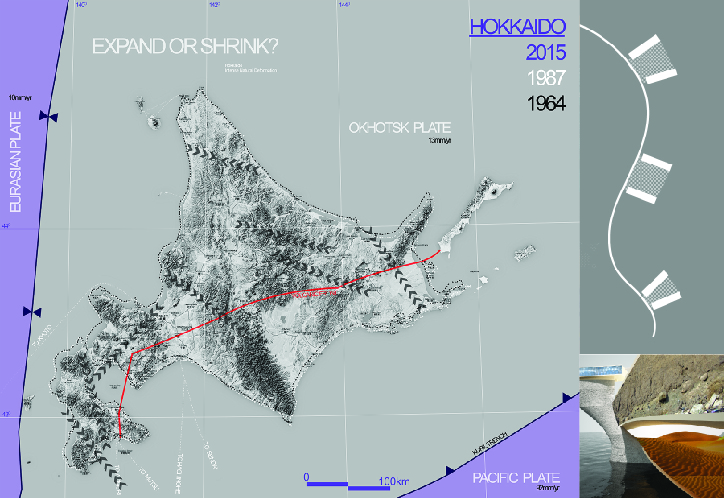
A slow architecture precisely tuned by the natural processes over time. Within the architecture, people can witness the reshaping of Hokkaido through the means of construction. The architecture frozen the moment the status of environment. The interaction between natural process and artificial process create a long construction process under natural environment. “Hokkaido, Expand/ Shrink?”, it is a controversial topic in Japan. Hokkaido is a northern island of Japan lying at the junction of three tectonic plates. The earth motion is intensively subtracting Hokkaido. Also, the unsheltered geographic location leads a strong ocean current and wind causing serious erosion. In contrary, these geologic and climatic factors bring frequent landslides throughout the years. That makes Hokkaido to expand. We cannot witness the change of environment by eyes unless we can compare with artificial objects due to different response action toward geologic and climatic factors. An Architecture should raise the awareness of change of earth skin.
Why?
The architecture permanence is always a major goal. Concrete buildings are believed to live for 175 years. In reality, we turn the common building into junk likely 50 years. As our future perception or advanced technology, we tend to rebuild a new building. Furthermore, the building material must decay responsive to the environment. The Spiral Jetty by Robert Smithson in1970 and the Double Negative by Michael Heizer in 1969, they are the landform architecture that created to react with the natural environment. Both reflected the intrusion toward constancy. In another perspective, the permanence is only a desire. In past, the brutalist looked at the true side of material. They embraced the ‘wasting away’ of material. As Kahn’s works, he exposed the imperfect of materials and showed how it created. Also, appreciation of aged materials was part of the design intent. Material played a key role in design. How?
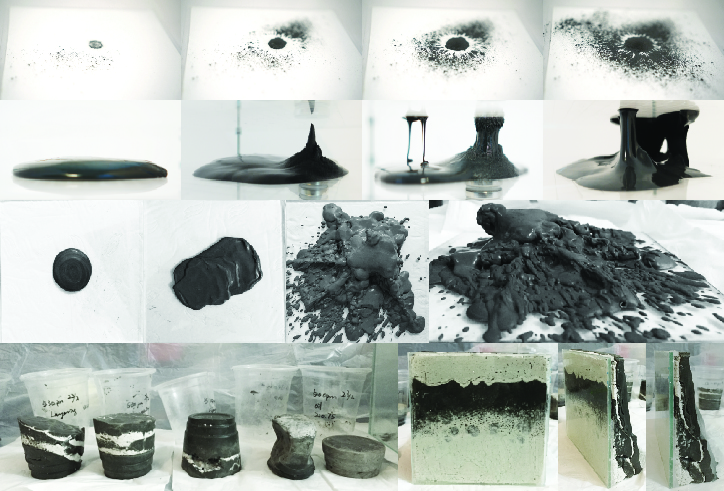
First, the state of materials are investigated. The unified constant materials are tested under different kind of forces such as attraction and accumulation. The materials deformed due to the magnitude of forces. The particles or molten form performed differently. Second, though the convention material cement, it showed the existence of natural forces such as wind, ice or gravity. The solidified result captured the direction, location of forces. Third, the estimate tests on scale and time are based on the interaction of natural environment of Hokkaido and artificial settlement. Bibliography
|