|
Rehabitation of Road Space
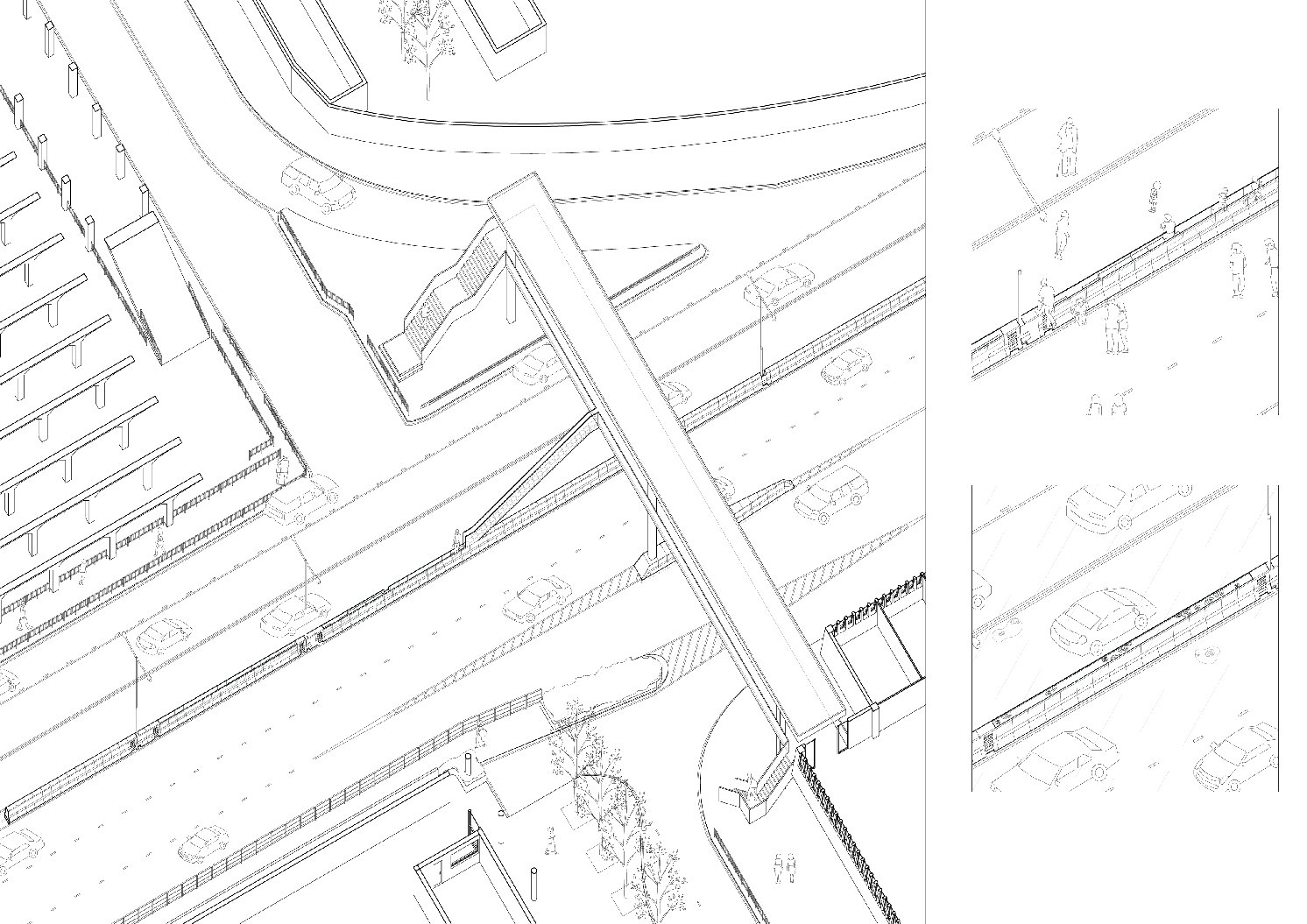
Through redesigning the road median barrier to become a park space. This thesis hopes to reengage with the possibilities of pedestrian habitation within the road network, to reveal and continue the history of Connaught Road.
WHAT?
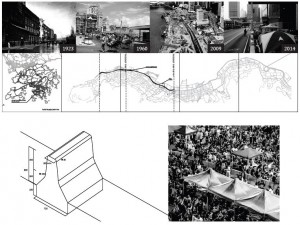
This thesis hopes to redesign the road median barrier into a public park, to allow for pedestrian habitation of the road network, to reveal the past, present and future of Connaught Road.
Hong Kong has 2094 km of roads, with a large concentration along the south of Hong Kong Island. Connaught Road was historically a public promenade, while up to the 1960s, people and cars both inhabited the road. In 2009, reclamation at Connaught
Road broke its connection with the water and its social identity. However, 2014 Occupy Central rose questions of public space on roads, reawakening the historical identity of Connaught Road.
The focus of the project will be on the Road Median (Crash Barrier). As a major monument, symbol and object on arterial roads, it is also the main obstacle in road habitation. Can this obstacle become a generator of a habitable road space?
WHY?
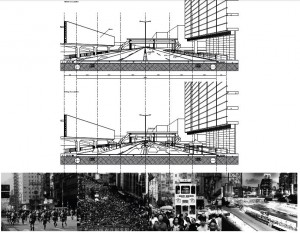
Historically, roads have been a prominent member of the greater architectural discourse.
During the 1920s, there was a huge celebration of the automobile, in Corbusian theory, roads became a device to connect and expand cities; Hilberseimer looked to roads to provide efficiency to the industrial city; While Wiley Corbett and Robert Moses had grand plans for people to give way to vehicles, and thus capital and efficiency. In the 1950s, the ability for roads to tear apart urban fabric and histories were brought to awareness. The Smithsons looked to methods of patching the city together for pedestrians; Archigram examined potentials for communities on the road; Situationist movements hoped to move the masses back onto the streets while noticing the destructive qualities of roads and capital development; Venturian theory embraced roads as an architectural space, where buildings became 2D symbols.
In contemporary discourse, projects such as Cheonggyecheon restoration looked to recover the history of the site and social significance of water. Broadway road reclamation to public pedestrian space directly challenges the capitalist ideals of New York, while showing the equilibrium qualities of cities, which always self-adjust. Highline Park redesignates industrial scale of railway into a human scale public park.
In Hong Kong, roads have traditionally been a stage of conflict, with riots, protests and 2014 Occupy Movement all taking stage on road space. They are also non-monoprogrammatic, with markets, event spaces all happening on road space, as well as its use as a speculative device evident in the Cross Harbour Tunnel and Castlepeak Road.
HOW?
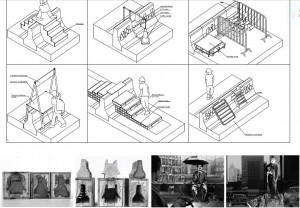
By studying habitation of the median barrier during the Occupy Movement, the thesis seeks to establish potential uses of the median barrier through relationships with the human body.
It will also examine the body configuration in response to objects. A study of the materiality of concrete will also be a vital component of the thesis, along with the idea of casting a solid object, to study solid void relationships for habitation.
BIBLIOGRAPHY:
Historical Theory:
1. Debord, Guy. “Unity and Division within Appearance”, Society of the Spectacle (Detroit: Black and Red, 2002), 54-72.
2. Rossi, Aldo. “Chapter 4: The Evolution of Urban Artifacts”, The Architecture of the City (New York: MIT Press, 1982), 138-161.
3. Rowe, Collin. “Crisis of the Object: Predicament of Texture”, Collage City (New York: MIT Press, 1984), 50-85.
4. Smithson, Alison. As in DS: An Eye on the Road (Baden: Lars Mullers Publishing, 2001).
Contemporary Theory:
1. Koolhaas, Rem. “The Double Life of Utopia: The Skyscraper – The Skyscraper theorists”, Delirious New York: A Retrospective
Manifesto for Manhattan (New York: Monacelli Press, 1997), 110-131.
2. Koolhaas, Rem. “Field Trip: A (A) Memoir (First and Last…)”, SMLXL (New York: Monacelli Press, 1995), 215-232.
3. Schwarer, Mitchell, “Automobile”, Zoomscape: Architecture in Motion and Media (New York: Princeton Architectural Press,
2004), 70-117.
Reference Projects:
1. Cook, Peter ed. “Open Ends”, Archigram (New York: Princeton Architectural Press, 2003), 74-85.
|