Hidden in the City

 Guangzhou South Railway Station

This station is in the southern suburb of Guangzhou which can significantly represent this category of suburb high-speed railway station. In this potential project, the site of station is considered to be reselected to avoid the disconnection between the city and the station. Meanwhile, the rebuilt station is supposed to serve as more than a “station” in terms of urban program.
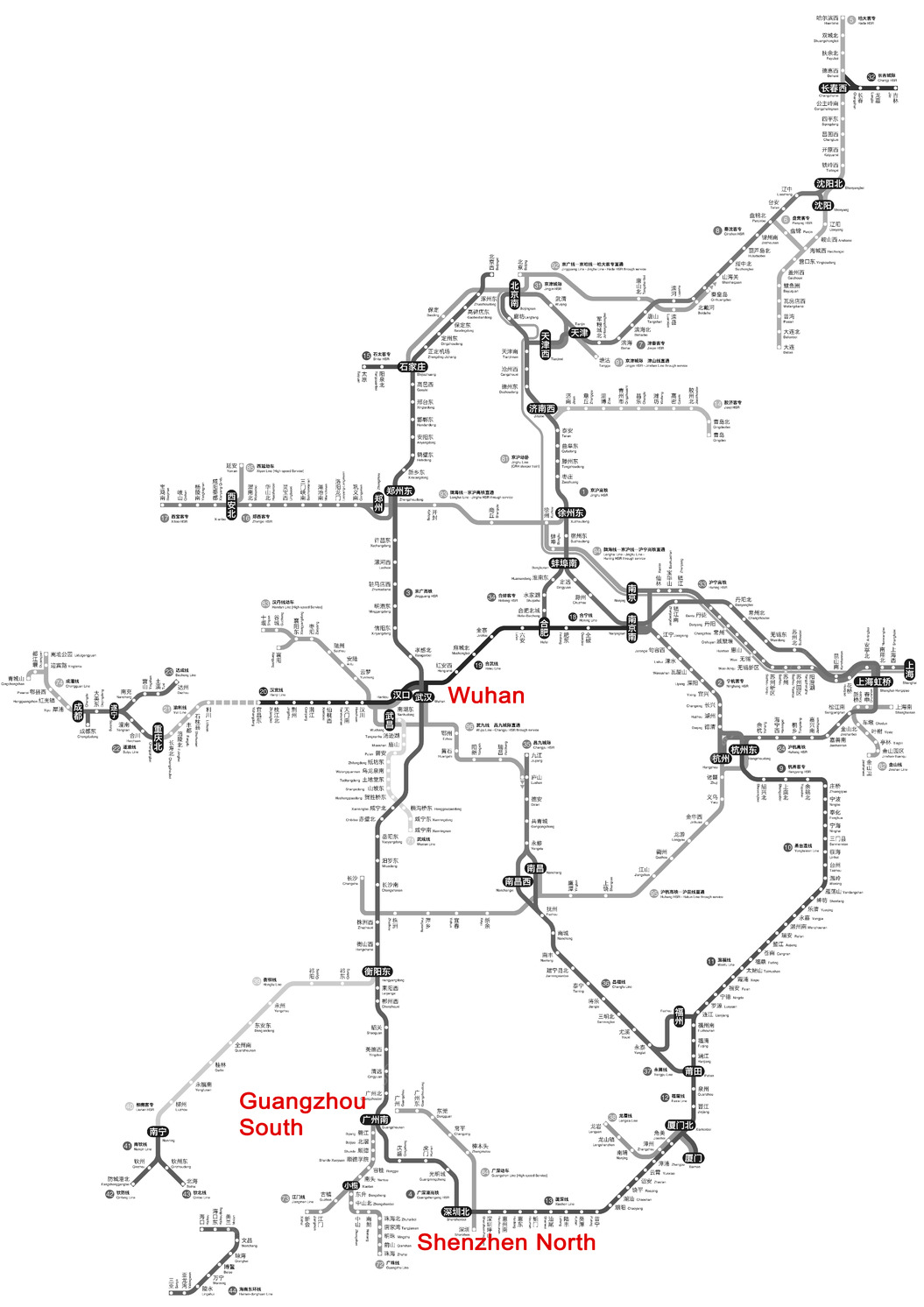
Several Important High-speed Railway Stations in China

With the development of the high-speed railway, the demand of the station quantity is increasing. Due to the different tracks of high-railways and common railways and the different heights of platforms, instead of being transformed from the existing stations, new particular stations are usually built in the cities for the high-speed railway.


A. Thesis Title
Hidden in the City

B. Thesis Statement
High-speed Railway is a different means of transportation, with higher speed, ballastless track and higher station platform, from the common train railway. Since 2008 when the first high-speed railway started to run, China has gradually possessed a very large scale high-speed railway net after constructing and transforming the existing railways into the high-speed ones. This modern transportation system almost cover all of the big and mid-scale cities and even more and more small cities.

With the development of the high-speed railway, the demand of the station quantity is increasing. Due to the different tracks of high-railways and common railways and the different heights of platforms, instead of being transformed from the existing stations, new particular stations are usually built in the cities for the high-speed railway.

However, the rapid development of high-speed railway net and stations increasingly causes the great impacts of them on the urban context. In some cases, the stations are built in the downtown without enough considerations about the relationship between the stations and the cities. Because of the special program of the stations, the disharmonious establishment usually causes many urban and environmental issues in terms of residence, urban transportation, space and texture. Indeed, some stations are located in the suburb to avoid complex urban issues in the downtown. But it disconnects the relationship between stations and cities. Therefore, the station which is divorced from the city usually serves only as a separate “station”.

From the above, the development environment of high-speed railway in China and the conflict between stations and cities are the main factors to drive me to confront the issue and commence this topic.

C. Potential Sites and Projects
Different cities and stations are under my consideration to be selected as the site and project. At this stage, three stations are potential to be selected.

1.) Guangzhou South Railway Station
This station is in the southern suburb of Guangzhou which can significantly represent this category of suburb high-speed railway station. In this potential project, the site of station is considered to be reselected to avoid the disconnection between the city and the station. Meanwhile, the rebuilt station is supposed to serve as more than a “station” in terms of urban program.

2.) Shenzhen North Railway Station
Shenzhen North Railway Station is located in the downtown with complex urban environment. Transition area and space between the station and its surroundings is supposed to be added and designed in this potential project. In order to “hide” the station in the urban context, the transition zone involves programs, urban texture and space.

3.) Wuhan Railway Station
In terms of geographic location and transportation strategy of China, Wuhan which is in the middle of the country is a very important city. Many railway lines from different directions go through Wuhan and thus the city possesses many railway zones and the stations have particular influence on the urban development and citizens’ life. Two proposed methods in the above are potential to be applied to this project. In other words, either reselecting the site and rebuilding the station or establishing a new urban transition between
the city and the station is potential.

At this stage, more research and information are still required to be applied to the confirmation about the site from these three selections. In any case, how to hide the station into the urban context and make it serve as more than a “station” is the subject.

D. Methodological Processes/ Outline of Research/ Design Experiments

1. Readings
1.) About the urban public space
2.) About public transportation architecture

2. Case studies
1.) Of pleasant public space, both of outside open space and inside architectural space
2.) Of Railway Stations built in different times within different culture

3. Analysis
Many cities in China have not only one railway station, so different existing stations and railway lines within the selected city are required to be analyzed to figure out the urban relationship among them.

4. Design
1.) Appropriately adjust and transform the railway lines, reselect the station’s location and re-plan the particular area.
2.) Establish the connections between the stations and the city or create a urban transition space surrounding the station.
3.) Research the urban transportation space and design the inside circulation and space.
4.) Complete the station design in terms of structure, facade and program.

E. Bibliography
1, Aldo Rossi, The Architecture of the City (Cambridge: MIT Press,1984).

2, Dietmar Eberle and Pia Simmendinger, From City to House: A Design Theory (Zurich: GTA Publishers, 2012).

3, Maggie Toy, Architecture of Transportation (Cambridge : VCH Publishers, c1994.)

4, Brian Edwards, The modern station :new approaches to railway architecture (London : E & F N Spon, 1997.)