
Introduction
“Rain Shadow” is created with Andy Goldsworthy himself laying down on the ground while raining so the part covered by his body becomes a dry body-shape imprint. Based on the analysis of Andy’s work, this report argues that “Rain Shadow” is a systemic three-step attempt – sensation, understanding, action – to motivate humans to seek a harmony with nature.
Manifestation of the Theme of Study
In terms of intellectual argument, Andy manifests his argument that “nature is organic” by documenting a series of slowly dissipating dry imprint. The changing shape of the imprint and finally the dissipation of it illustrates nature is, in the same way as the imprint, organic and thus each natural process is transient.
In terms of artistic means, Andy adopts the most direct way to create “Rain Shadow” – with himself laying down on ground while raining. By making use of his own body to create the art work, Andy is trying to say that humans can understand nature by immersing ourselves into nature, just like how he understands “nature is organic” by his own body.
In terms of the dissemination of artistic idea yet addressing to environmental issues, the act of Andy to cover part of the ground to protect it from rain symbolizes that humans can do something to change nature. Additionally, his work addresses the limits of human bodies relative to the climatic force of nature. Since one person can only protect a small part of the ground from rain, Andy is trying to imply that a collective effort is necessary in order to seek a harmony between humans and nature.
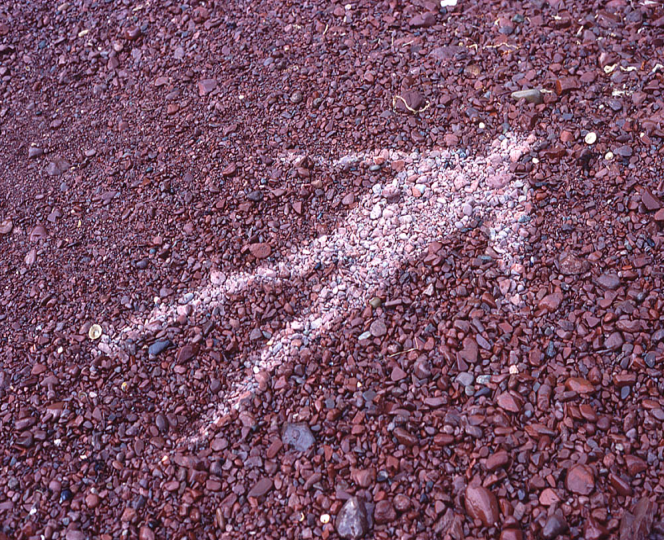
Photo 1 Laying down on ground in rain
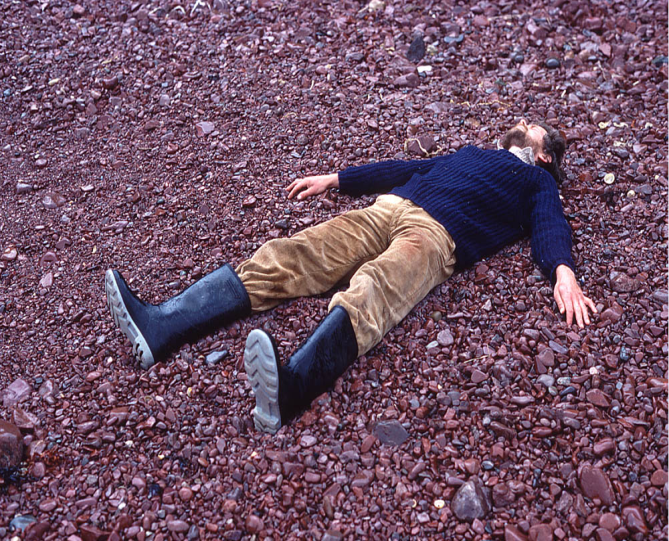
Photo 2 A dry imprint is created
Discussion
By following how “Rain Shadow” is created from beginning till the end, we can appreciate a systematic and inventive three-step approach adopted by Andy Goldsworthy in provoking humans to seek a human-nature harmony – sensation, understanding, action. First, Andy begins with bodily sensation with nature. To lay down on the ground is one way to sense nature directly, which is important for understanding the relationship between humans and nature, particularly the limits of body. According to Boetzkes, “……touching, seeing, and in one case even tasting natural activity as a detection of bodily limits……”(1) Thus, in the case of “Rain Shadow”, it is highly appropriate for Andy to lay down on ground to understand the limitation of one person to protect the whole ground from rain. Without laying down, it would be difficult for humans to experience how limited is the power of an individual compared with the climatic force of nature. In short, the first step – bodily sensation – makes it possible for humans to understand their limits and thus it is useful in provoking humans to join hands to seek a human-nature harmony, since it would be impossible for one single person to achieve.
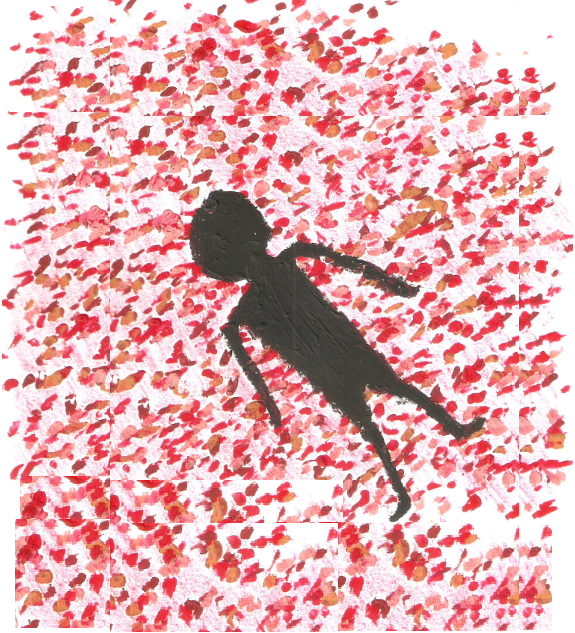
After a bodily sensation which fosters understanding of body limits, the gradual dissipation of the dry imprint further leads humans to understand “nature is organic”. Such understanding is a prerequisite for progress in the dealing with environmental issues. As what Botkin have said, “Solving our environmental problems requires a new perspective …… that everyone perceives the world…….the changes that must take place in our perception (is the) recognition of the dynamic rather than static Earth……”(2) Thus, the documentation of the changing shape and dissipation of the dry imprint is an important part in illustrating the perception that “nature is organic”. With such perception in mind, humans are provoked to do something to constructively change nature because “Such confusion (confusion of Earth as static) tends to lead those concerned with conservation of the environment to emphasize the benefits of doing nothing and assuming the nature will know the best.”(3) In short, the second step – understanding “nature is organic” by a series of imprints – is highly useful in motivating humans to take action in seeking a human-nature harmony.
Sketch 4 Original imprint
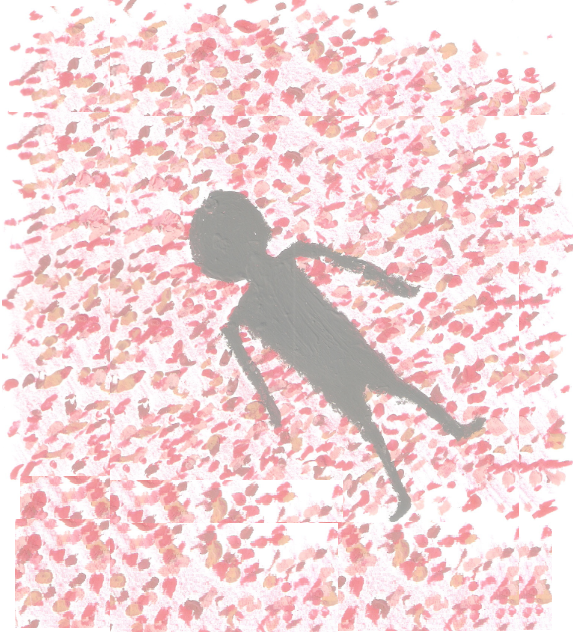
Sketch 5 Imprint is gradually dissipated
The last step is action, which means mobilizing humans to participate in the process of seeking a human-nature harmony. To achieve this aim, Andy repeats the art work at different locations, showing that if more people join in the action, more grounds can be protected from rain, which is actually symbolizing the concern towards environmental issues. Most of his work is done in the suburban areas of a city such as St. Abbs, Scotland in United Kingdom which aims at bringing back urban dwellers to nature. The repeated creation of this art work is appreciated as it draws the attention of more audience so the effect of raising public awareness towards environmental issues is bigger.
To conclude, “Rain Shadow” is much appreciated as it systemically provokes humans step by step to reflect on or even work constructively on the relationship between humans and nature. It starts with bodily sensation with nature which lets humans understand body limits, followed by a series of changing imprints to let humans understand “nature is organic”, and finally mobilize humans to seek a human-nature harmony by repeating the art at different sites.
(1) Boetzkes, A. (2010). The Ethics of Earth Art. University of Minnesota Press, p.146.
(2) Botkin, D. (1992). Discordant Harmonies: A New Ecology for the Twenty-first Century. Oxford University Press, pp.5-6.
(3) Botkin, D. (1992). Discordant Harmonies: A New Ecology for the Twenty-first Century. Oxford University Press, p.8.