Archi-social Community Urban Project
 Domestic Helpers in Hong Kong Domestic helpers working in Hong Kong have the short end of the stick. They not only have to live in a city that is foreign to them, but they also have to be away from home and their loved ones. They don’t really have a place that resembles their homes in Hong Kong. They therefore lack a sense of belonging which every person should have. Many factors contribute to this: there is the obvious language barrier, they only earn minimum wage; entertainments and leisure activities are expensive in Hong Kong, they have limited access to educational, cultural, recreational, professional and social facilities, resources and information relative to other residents of Hong Kong. In addition, they face constant discrimination and irrational anger or dislike from the local community i.e. as a result of the Hong Kong Tourist hostage crisis in Manila which has lead the locals to associate domestic helpers with the Philippine Government and incidences of physical abuse by employers towarddomestic helpers. These cumulative factors inevitably result in domestic helpers feeling isolated from and being isolated by the local community. The thesis project aims to provide a space where domestic helpers can come together and avail themselves of their rights of education, religion, use of public space, human rights. It is also hoped that this space can serve as the melting pot or merging center of different communities of the minority groups in Hong Kong. Through this space, a multi-cultural neighbourhood can temporarily exist and reinforces Hong Kong’s reputation as Asia’s world city. It is hoped that this space can educate its target visitors/users by giving them more information on various topics such as current events, laws, languages or even simply general knowledge. The space is also intended to entertainment its users by providing them with more activities to do. Hopefully, this helps them grow and explore their potentials as individuals and give them a sense of self-worth. More importantly, it is hoped that the space gives them a safe haven or refuge from local discrimination and isolation. Here they can be free from criticisms or judgment. They can be themselves as well as give them some sense of ‘home’ where they belong. I wanted to create an installation and/or make use of abandoned places such as spaces under bridges that serves or provides equal opportunities to the domestic helpers without doors or borders which caters to all these existing issues. It will not only make better use of the space but also benefit domestic helpers.  Domestic Helper in Hong Kong abused by her employer 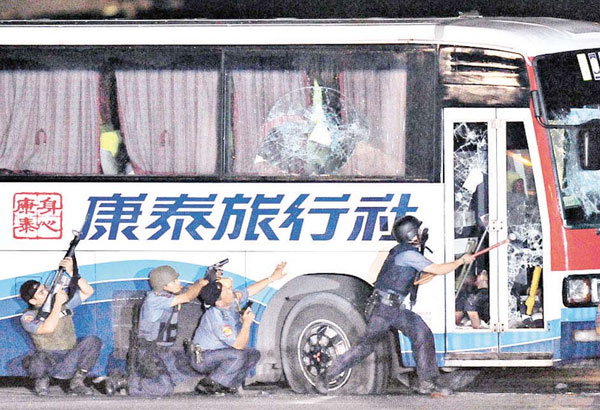 Hong Kong tourists hostage crisis in Manila There are three types of approach for my thesis. Firstly, a temporary installation may be designed that could be set up and taken down every weekends. Secondly, an improvement can be made to their existing resources or places they use and thirdly, proposing to make better use of the abandoned places in Hong Kong i.e. left over spaces in parks, road, under the bridges and many more. A temporary installation may be set up every weekends i.e. Sundays when most of the domestic helpers have their day offs, on different locations such as in the ground floor of the HSBC main building in Central; the football pitch in Victoria Park in Causeway Bay; Kowloon Park in Tsim Sha Tsui. These are the prime locations where domestic helpers gather or which has space big enough to accommodate domestic helpers who gather in groups amongst themselves. This installation would include spaces for religion, education – language corner / books / law and legal rights, food – their local delicacies, activities such as yoga. As mentioned before, this installation will be located where domestic helpers in Hong Kong congregate during weekends or during their day- offs in order to show that we are reaching out to them. Most of the existing resources of these domestic helpers are not put into good or maximum use. It is unclear why and I am curious why. I will investigate into this to ascertain how to improve or help resolve these issues and improve their existing conditions. In addition, we can physically see that domestic helpers do not have or have limited access to the resources or public facilities of Hong Kong. We could also observe that many awkward, unused or deliberated blocked spaces in Hong Kong. If this is the case, why don’t we propose to the government to make better use of the space. This could be a starting point for different ideas to apply to those spaces. All of the proposed projects will be run by voluntary groups and/or NGOs including voluntary domestic helpers themselves. These domestic helpers have been serving people of Hong Kong directly or indirectly without anyone giving them any favour in return. I think this would also be a great opportunity to serve or help them back. This thesis highly involves the input and the feedback of the subjects. The methodological process starts from interviewing the subject groups about their existing problems as well as their needs. I would need to understand and ask them about their suggested solution(s) to the issue(s) they have. Furthermore, I could start mapping out the activities, places, fundings and possible resources that they have and compare it directly to what activities, resources and places they actually use. This could reflect whether or not they are limited on what they could have or do, and why. This ‘why’ could be a solution to help them with their issue(s). As mentioned in my thesis statement, I would like to make an installation (permanent or temporary), therefore, I would be looking at existing laws and regulations to allow this type of installation to be built as well as to allow such installation to operate. Assuming that I could set up an installation somewhere, I would be looking for volunteers in Hong Kong such as non-government organisations, churches, law firms, yoga instructors, language tutors, catering services and many more to help and provide services to domestic helpers in Hong Kong. This hopefully would allow them to have more resources, education and activities. In addition, I would apply for fundings from different embassies and organisations to continuously support the programme. If everything works, I would assess the programme by direct feedback from the domestic helpers, observations, and by the number of people using the services that we provide, either increasing or decreasing. Also, if more and more funding would be provided by different organisations. After this, whatever outcome it may reflect, then there will be necessary further action(s) or step(s) to be considered.
|