In Touch with Soil – Urban Agriculture
|
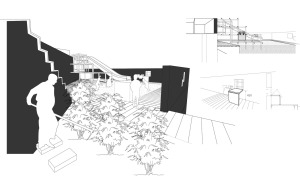
Statement Facing the ‘Urban-development’ in Hong Kong, agriculture land had long been changed into New Town to receive the demand of population. North East New Territories Development awakes people the importance of local agriculture not only about importance of food diversity, but also the purism of land use in Hong Kong. “To understand cities, we have to deal outright with combinations or mixtures of uses, not separate uses, From Project to Thesis Agriculture is no longer being considered in the urban planning in Hong Kong. In the progress of development, Agriculture was treated as an abandoned and fruitless choice of land use. Limited Land and valuable light resources are often used to challenge farmland in urban. However, the multiple ground situations in Hong Kong create possibilities. Rooftops are used in small scale farming as interests and also effectively reducing the heat absorption like green roof design, but in a productive and self-manageable way. Continue with the last semester research about rooftop agriculture, the topic can be extended to an urban scale to challenge the value of agriculture in 22nd century. Base on the arguments of ‘Purism’ of Le Corbusier, ‘Living City’ of Frank Lloyd Right and also the Diversity saying of Jane Jacobs, but in 70 and 50 years ago respectively, I would question, Hong Kong as a City of purism, could agriculture be considered in urban planning not only in the format of Peri-urban agriculture (although only a few left), but integrating with urban landscape as public space to form a strategy and model of urban planning which improves the urban living quality and ecology in the form of public space. as the essential phenomena.” By Jane Jacobs The Developments in Hong Kong only tackle with the instantaneous problem but lack of providence. The combination of commercial and residential use of lands can solve the problems of jobs and live but also kills the life if a city. It is a machine life of living at home and working in office. The need of public space in Hong Kong would never be less. People start to find escape to green by farming planters on rooftops. However, asphalt and concrete separated human from soil and earth, which can only be found in countryside. Machine only talks about efficiency, but human talks about living quality, beauty and emotion. People in Hong Kong need to have a touch with soil. Methodology TheMajorLandDevelopmentsinHongKongarethe expansion of New Territories and the redevelopment of oldareas.So,thethesismayhavetwositesinHongKong: one is the North East New Territories development proposalandtheotheristheShumShuiPo Redevelopment. The First one is to convert a large, rural agriculture land into a new urban area and the later one is to redesign the crowded urban space. The two sites chosen are also facing the protests and disagreements by the local residents supporting local agriculture and culture. By reviewing the local context and also the proposals suggested by government, new proposals would be suggested to areas by deciding to keep or to change those elements. Finally, a general rules and guideline could be used in future urban planning which includes agriculture. On the other hand, rather than utopia farming tower, detailed farming device could be made to enrich the design, which could be workable and dependable for citizen to get the place of farming as a improvement of live quality. It may be a portable farming devices, which could be brought between home and Agri-public space so that agriculture could have a new interpretation about the Internet and connection of space. Bibliography 1. “Thelivingcity”,FrankLloydRight,NewYork: Horizon Press, 1958. 2. “Theeconomyofcities”,JaneJacobs,Middlesex: Penguin, 1972. 3. “Continuousproductiveurbanlandscapes: designing urban agriculture for sustainable cities”, Andre Viljoen, Oxford : Architectural Press, 2005
|