|
ARTIFACTS
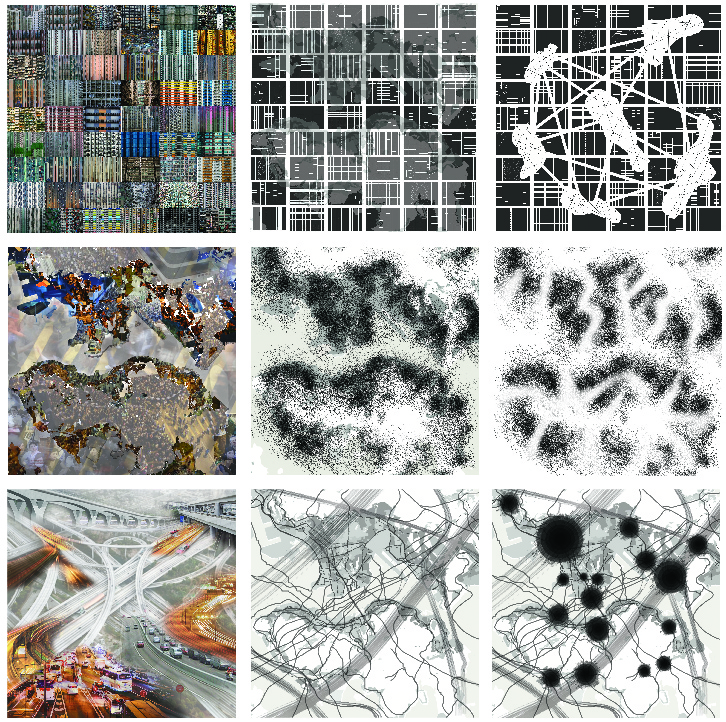
Imagining that the density is getting higher and higher, buildings, people and vehicles are everywhere. Many problems like heat island effect, canyon effect are created. The urban ecology of the city is completely out of balance. We cannot find a breakout from this packed high dense packed city. Where is our nature? Why are we isolated ourselves from it? What could we do if we want to get it back?
WHAT?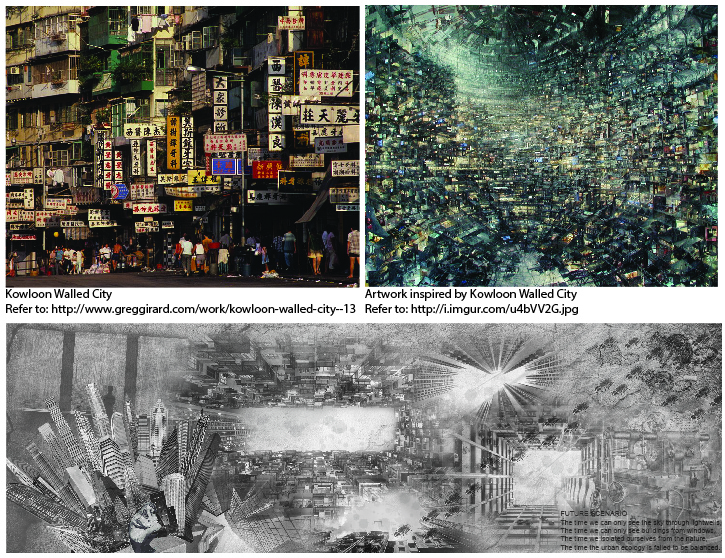
GREEN INFRASTRUCTURE
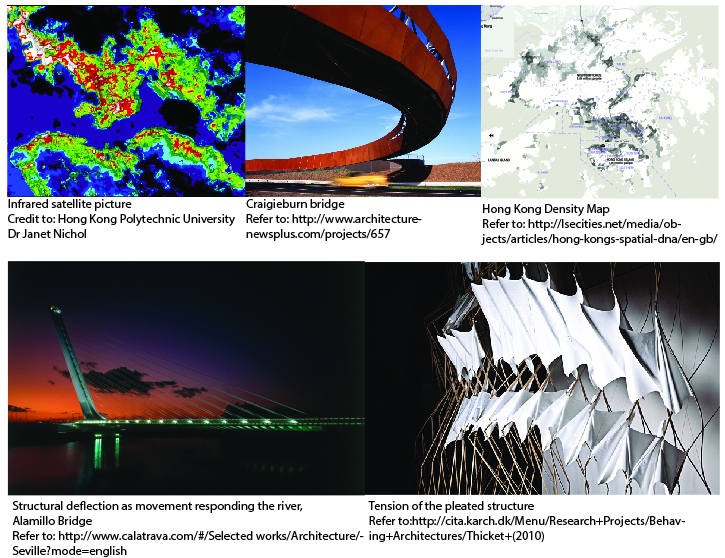
In Hong Kong, density is always a big concern of the city. To protect the countryside and to meet the needs of growing population, increasing plot ratio seems to be unavoidable. Plot ratio has increased to 15 last year. How can we solve the urban deterioration problem at the same time of solving the original problems? To achieve a balanced urban ecology and to keep the density of the urban city, we have to bringing the city back to the nature. Connectivity between the nature, city and architecture is the main focus of this project.
As an architectural tool, green infrastructure is a network providing city the ingredients for solving urban and climatic challenges by building with nature. Reviewing urban ecology’s potential role as an infrastructure, it is used to improve the urban deterioration.
WHY?
URBAN DETERIORATION
Urbanization is a rapid modern phenomenon among all the developing countries. Due to the increasing concerntration of people and economic activites as well as a growing vehicle fleet, urbanization expands rapidly. Office towers, residential blocks, people, viehcles, roads, bridges and highways, etc are all increasing in number. Densification leads to an urban deterioration. The time the urban is expanding, the time the city is being isolated from the nature. Urban deterioration causes other side effects such as heat island effect, anyon effect,etc to the urban city which is like a chain effect.
Imagining density is growing up and urban is deteriorating, what will the city actually look like and how will the city function if it continues to be urbanized, at the same time, to be cut off from the nature.
HOW?
STATIC/DYNAMIC ARCHITECTURE WITH MATERIALITY
“Living systems do not passively respond to events the way a leaf blows in a windstorm. Rather they actively turn whatever happens to their advantages, constantly redefining themselves, operating under their own self-defined behaviors. They have a structure, coherence, and self-regulation that allows them to bring orders and chaos into a special kind of dynamic balance.” Kathy Poole, a landscape architect.
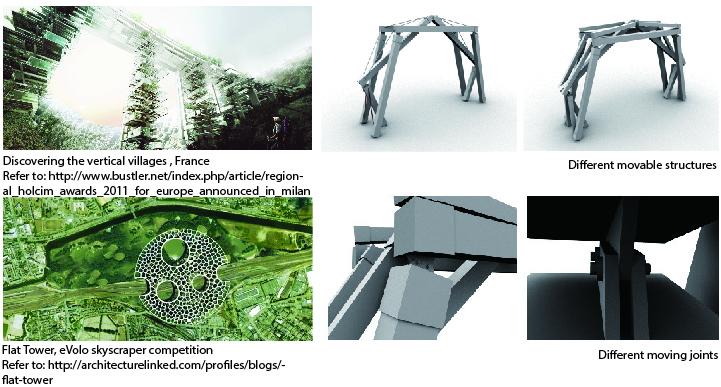
This project is to respond to the unpredictable behavior of nature with static/dynamic behavior of architecture. There will be three stages for this project. First, it is to study about the urban nature such as wind, water and eco climate, etc. and to find our a global urban strategy. Second, it is to define the processes and also the dynamics which allows the architecture constantly making something new of itself. Third, it is to apply the defined system on the architecture with materiality. The architecture can be a façade design or a structure design.
BIBLIOGRAPHY:
1.Julian Raxworthy, Jessica Blood, 2004, The Mesh Book: Landscape/Infrastructure,
RMIT University Press, Melbourne
2.John Marzluff, Eric Shulenberger, Wilfried Endlicher, marina Alberti, Gordon Bradley,
Clare Ryan, Craig ZumBrunnen, Ute Simon, 2008, Urban ecology: an international
perspective on the interaction between humans and nature, Springer Science &
Business Media
3.Stan Allen, 1999, Points + Lines: Diagrams and Projects for the City, Princeton Press
|