Rethinking Architecture in the Age of Big Data
|
WHAT? “…, by now almost nothing that happens benefits storytelling; almost everything benefits information . . . It is left up to him to interpret things the way he understands them, and thus the narrative achieves an amplitude that information lacks.” – Walter Benjamin The rise of ubiquitous data and the internet of things have called for a new understanding how abstract information gains a physical presence – albeit, a physical presence that does not merely represent the data, but meaningfully react to it. By definition, the architect is an agent of change and in this thesis, the change due to the new social context of the digital environment, which should be claimed and brought in by the architect, is examined.
Architecture: the Real and the Virtual Architecture is the realization of the virtual – it inevitably channels all the social, political, economic and hence ideological forces behind the scene through its materialization. In the time of Le Corbusier, the machine took over the world and changed the way we moved, we perceived, we worked, we capitalized, and we built… through which we called modernization. And through what we built the essence of ideology was transmitted through the architecture and lived on in a physical form to inspire the new. While people like Manfredo Tafuri believes in the rigidity of the system, others like the Contructivists, the Situationists… looked at the crack of it… Consider the larger part of discourse of architecture, it often goes beyond the physical to reach its metaphysical realm – Architecture lives upon the materialized presence but it never stops at the level of concrete, brick and steel; and therefore, Architecture is never detached from social changes at all times. It is indeed the architect’s duty to engage in the transience of the world.
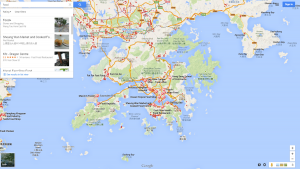
WHY? The Impotence and Omnipotence of 21st Century Architects Today, we live in the age of ‘Big Data’. The thesis is NOT about digital software, NOT about electronic hardware, NOT about parametric design, NOT about grasshopper… but about how technology could shape and be shaped by architecture and urban design. For example, smart phone apps like google map, Yelp, Openrice … and various digital info-mapping programs have their impacts on how one reads the city – psychogeography digitalized – echoing what the Situationists proposed the experience of the city is no longer an individual empirical documentation but could be a collective statistical experience… And for instance, Project Tango is a digital campaign revolutionizing the reading of space and form by machine, where all these could become data in computer realm… All these pop the questions that what social changes could it bring about and what we can do about these changes as architects? What if these apps can induce or interact with physical changes and events of the architectural and the urban? What if an app can suddenly control, say an installation, and influence the space nearby? Virtuality is dangerous for it is imagined and everything that is imagined has no boundary. All revolutions begin with ideas. For example, ‘bitcoin’ is designed to be a currency which paves way for a world of anarchy by replacing the real – for the real, we often imply the authentic, the authorized… Another example is ‘kickstarter’, where a Joe can start his business with less costs which is a means to oppose the monopoly of some international groups… For my thesis, the quest is to devise the means of intervention or opposition in terms of space and architecture, through the materialization of the virtual to tie it back to reality. The emergence of ‘Big Data’ implies a crisis for the architect – Are we losing grounds to gadgets? Or, can we claim a stake to the beginning of a new era? The Political, The Social, The Economical, & The Ideological The work of Lebbeus Woods more than often express the oppositions to the authority, although they are never built. The government office building designed by Rocco Yim is a proposal that celebrates the right of democracy as the architect drew the space for demonstration, but in reality the owner of the building destroyed the architect’s intention by placement of barricades and fortification of the entrances, which is a critique to the architect’s work. Deliberately or not, architecture can hardly leave the discourse of the socio-political-economical domains. For my thesis, these questions shall be explored as the ultimate issue that is related to the subject issue, or, its projective implications. For
HOW? Precedents – Pioneers Fun Palace – Cedric Price – Old form of responsive architecture which allows interaction of people with the building element and space – what if it is in today’s context and is done in an urban scale? Living City – David Benjamin – Buildings with sensors on air qualities and fins to re-direct wind flow can literally talk to each other, in an attempt to combat heat island effect in the city of New York. Drawing in Air – Natalie Jeremijenko – Building façade that can absorb air pollutant particles – What is it becomes a common façade material of the city? Methodology – Paranoid Critical Method The methodology deployed in the thesis is the Paranoid Critical Method, by Dali, the surrealist. Under this methodology, both the rational and the irrational phenomena (related to the issue of Big Data and the City) are examined to give a full picture of the scenario and analyzed in a hyper-critical manner. Several case studies across the globe about the influence of information on Architecture will be examined to study the current situation. Second phase will be a analytical drawing exercise to describe 7-10 case studies across the city to illustrate the case in the local scale. Third step will be a series of interventions about these sites to draw a larger catalogue of ideas to outline the motif of the thesis, where interactive installations will be the proposals for the physical resemblance of the virtual realm of data. Although the thesis involves the glimpse into the intangible domain suggested by the technology, tools like drawing and model making are still the major assets of the architect, where to us, to draw and to make is to describe, to describe is to observe, to observe is to analyze, to analyze is to devise, to devise is to transcend, to transcend to a new page in Architecture. Besides, these two mediums, other techniques like filming and possibly app writing could also be involved in the experimentation and representation of the subject issue. Site – HONG KONG, SHENZHEN Hong Kong and Shenzhen are the potential sites, because in these two cities, there are issues that relates to the intertwine between the real and the virtual thanks to their advance being, as well as political and social reforms and they are vibrant cities that are good test grounds for the thesis. Part of my thesis agenda is to investigate the cultural side of architecture in new South China…. Bibliography 1. Rem Koolhaas, Delirious New York: A Retroative Manifesto for Manhattan, Oxford: Oxford University Press, 1978
|