 Sequence of Two Journeys
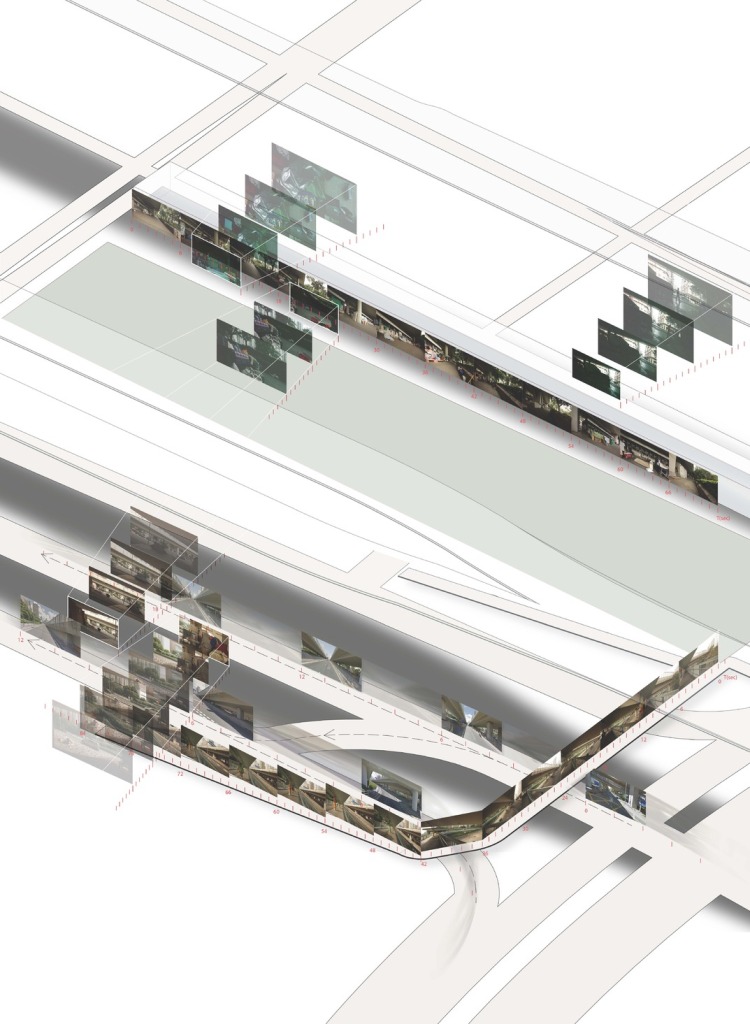
Spaces are remembered according to its perceptibility. Human minds sometimes work like montage sequence in filmmaking – fragments
of spatial perceptions on various destination places are remembered and juxtaposed in a single sequence.
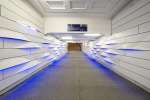
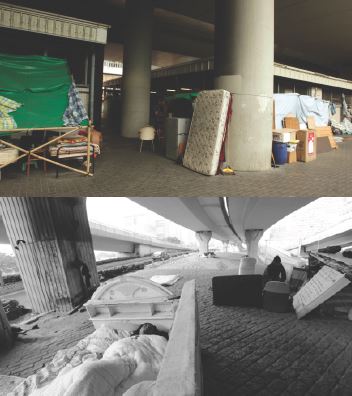
Based on how the homeless and the commuters (pedestrian and vehicular) uses the space underpasses flyover differently in terms of speeds, view angles, distance, durations, movement, etc., two sets of sequential perceptions will be developed on the same space; as if two distant films can be produced out of the same set, using different frame rates, camera angles, focal length, shot duration, camera movement, lighting, etc.
WHAT?
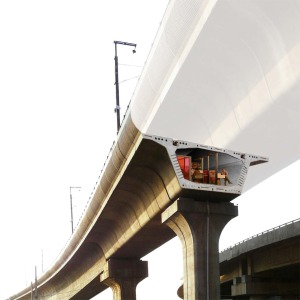  
Duality of [Infra]Structure
Infra- refers to the prefix meaning below; infra-structure literally means below the structure.
Departing from the proposition of “the Double Life of Transport Infrastructure”, the interest of this project lies on how the same circulatory
infrastructure can be multivalent and used for two groups of people – commuters and the homeless, with an eye towards the cinematic where atemporal juxtaposition of programs will be explored according to how the two groups use the space differently,
just like how a single set can stage different films. This thesis aims to design a journey (of the commute) as well as an experience
(of the habitat) that are both transitional and destination.
WHY?
   
Overpass as the Site of Urban Montage
Infrastructure is the site and accelerator of montage urbanism. Advancement of modern transportation intensifies the spatial fragmentation
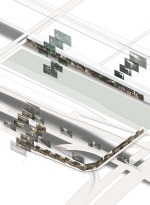
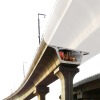
and dislocation by bringing people from one destination to another through the ubiquitous context-less tunnels. The very cognate qualities for an efficient transport translate into the optimal conditions for settlement for the homeless. The underpass of West Kowloon Corridor in Hong Kong offers contextual potentials as the site of urban montage where new developments and the decaying city meet. Existing homeless population concentrates at two sites under the flyover – on Ferry Street where the different road types intersect, and on Tung Chau Street where the temporary market building creates extra shelter for the homeless.
HOW?

Montage and Promenade Architecturale
Catalog existing adaptations of infrastructure from the homeless. Analyze their respective spatial quality of each in terms of view, privacy, temperature, lighting, etc. Examine the relationship between the habitat and movement at each based on how the homeless,
passenger and pedestrian use the space differently with variant speeds, view angles, distance, durations, movement, etc.
Study the attributes of cinematography and experience within architecture, such as the “promenade architecturale” of Villa Savoye.
Establish sets of spatial sequence for different users under the overpass where different experiences and journey may weave or depart at points of interaction or isolation. Propose series of interventions that work together through time.
|