Vessel Architecture: Deconstruction & Reassembly
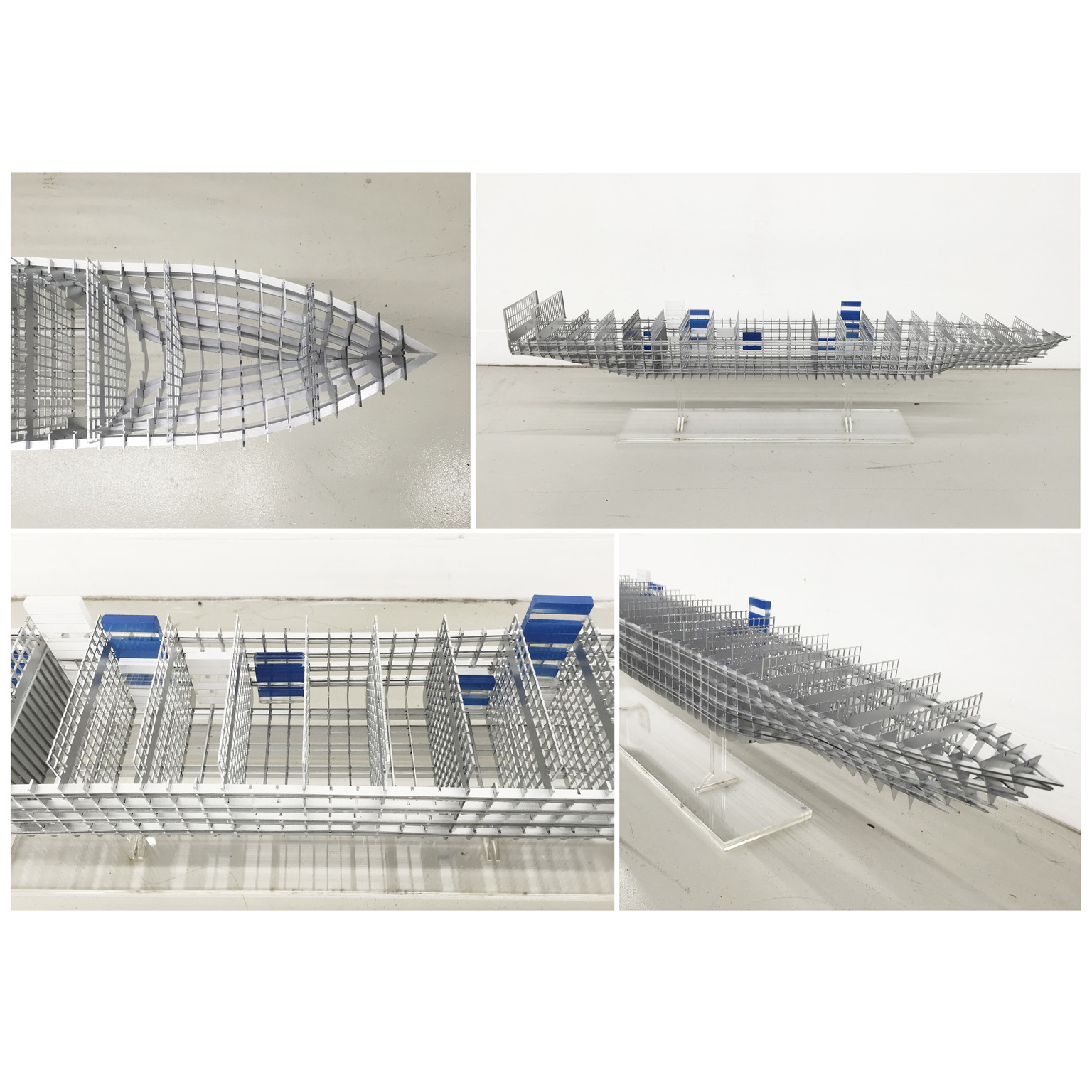 [1:300 model of Shenzhen OOCL container ship. Built in 2003 the ship is expected to retire within the coming decade and serves as source material for redesign of vessel] 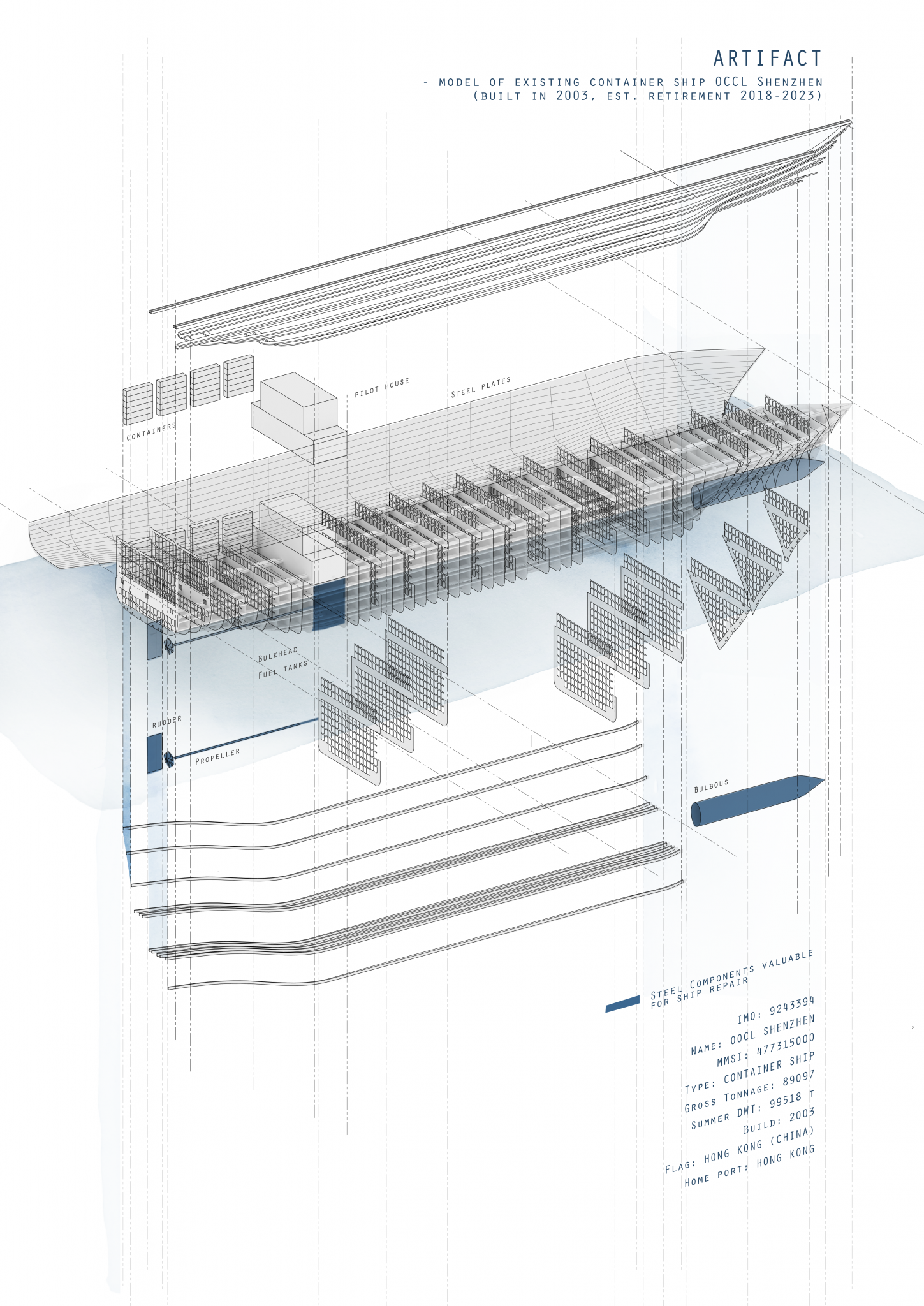 [Exploded axonometric showing outer steel plates which are valuable for recycling, and longitudinal and transverse hull frame which may be converted to architecture] My thesis investigates how decommissioned large ships could be strategically dismantled and remodeled into architecture, specifically housing and working docks/piers for 20,000 ship breaking workers in the Chittagong Shipbreaking Yard in Bangladesh. The thesis explores subtractive and dissective methods of breaking down relevant models of container ships, bulk carriers and oil tankers built from ~1990 to 2000 (estimated to retire in the next decade.) For the housing component, the thesis examines ways to make old ships habitable through considerations of indoor and outdoor qualities, lighting and ventilation, and the urban experience. Ships are striated in design: lower decks indoors-upper decks outdoors. The texture of indoor outdoor space is limited. Beyond this the hull space is constructed to carry containers and bulk cargo such as ores making it a claustrophobic and air-tight environment. This thesis aspires to diversify the ecology of ship habitats by experimenting with its indoor outdoor capacities and connection to shipbreaking infrastructures. For the working docks/piers, the thesis identifies chemical and oil tankers (too toxic for habitation) as potential material for breaking and reconfiguration into facilities in the shipbreaking yard. Out of the three types of shipbreaking: breaking in dry docks, breaking by pier and breaking on shore, the last is the cheapest, most hazardous and current method employed in Bangladesh. Building infrastructure would allow for the first two methods to facilitate the shipbreaking operation. 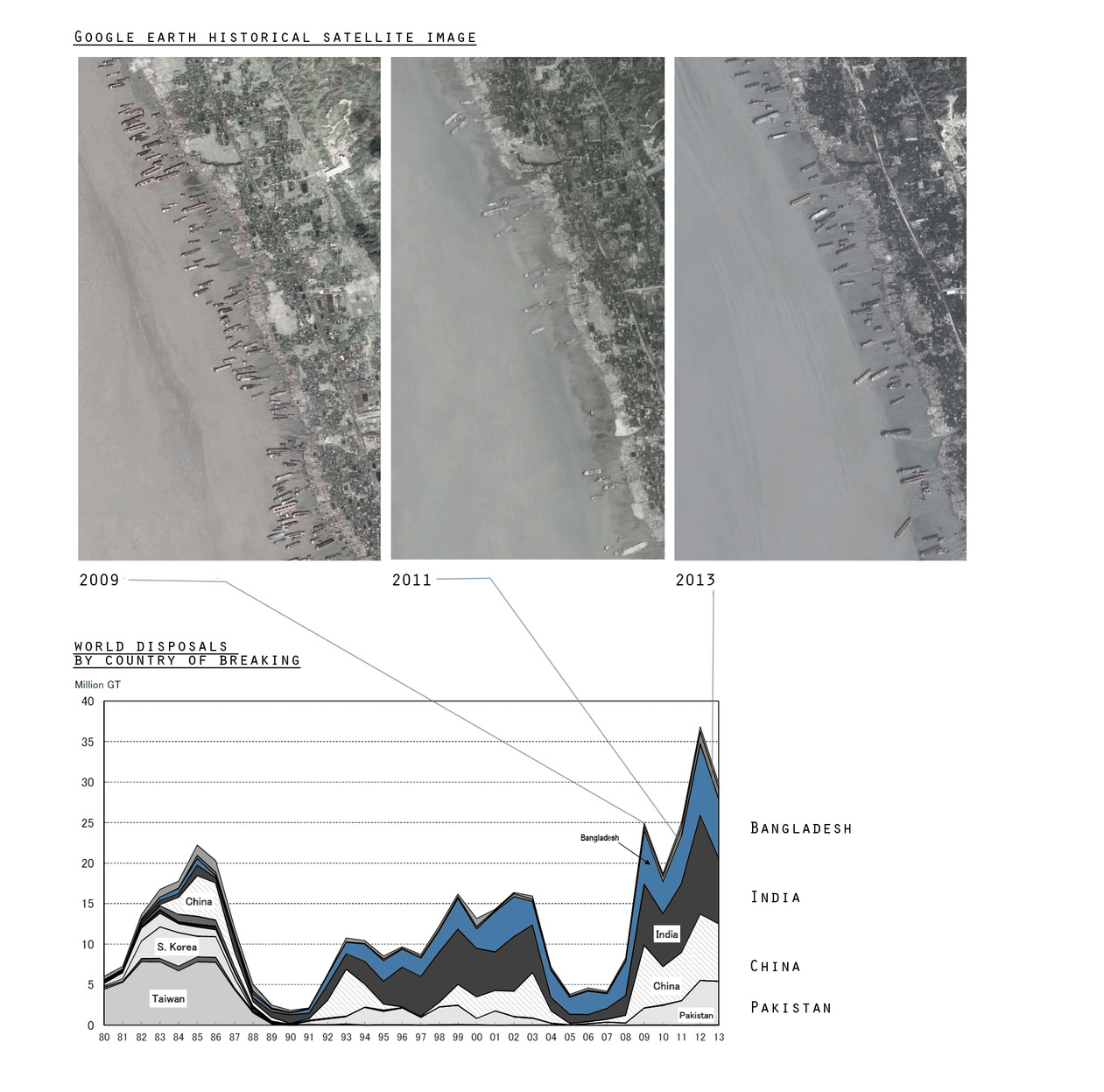 [Satellite images of Chittagong and world shipbreaking volume from 80-13 (source: The Shipbuilder’s Association of Japan). Geographically shipbreaking industry provides rapidly urbanizing developing countries with recycled steel. Temporally speaking the boom in shipbreaking coincides with slump in marine trade (08 financial crisis)] Bangladesh is chosen as the test ground as it is currently one of the biggest players in the world shipbreaking scene, due to its low wages and lax environmental regulations. Recycled scrap from the shipbreaking industry contributes to half of the country’s construction steel but at the expense of the environment and workers’ well-being. Currently 25% workers live in overcrowded sheds in the shipbreaking yards and the rest in slum settlements nearby, where poor sanitation promotes spread of disease. The dire lack of affordable housing is also exacerbated by annual flooding and displacement. Albeit starting with Bangladesh as a test case, the thesis’ aim of housing provision and structural experimentation through recycled ships may find extended application in other shipbreaking countries such as India and Pakistan. The notion of recycling and alteration of maritime components is not new to architecture, yet much of the focus of the discourse has been on the reassembly of shipping containers which are unitized and moveable (as in projects by Wes Jones, Lotek and Shigeru Ban). The slow deconstruction process of a ship follows, instead, a methodology of cutting away from the large structure before reassembling the extracted components into new potential forms. The static subtracted form (remainder of vessel) and the scattered moveable components offer different opportunities for spatial configuration. 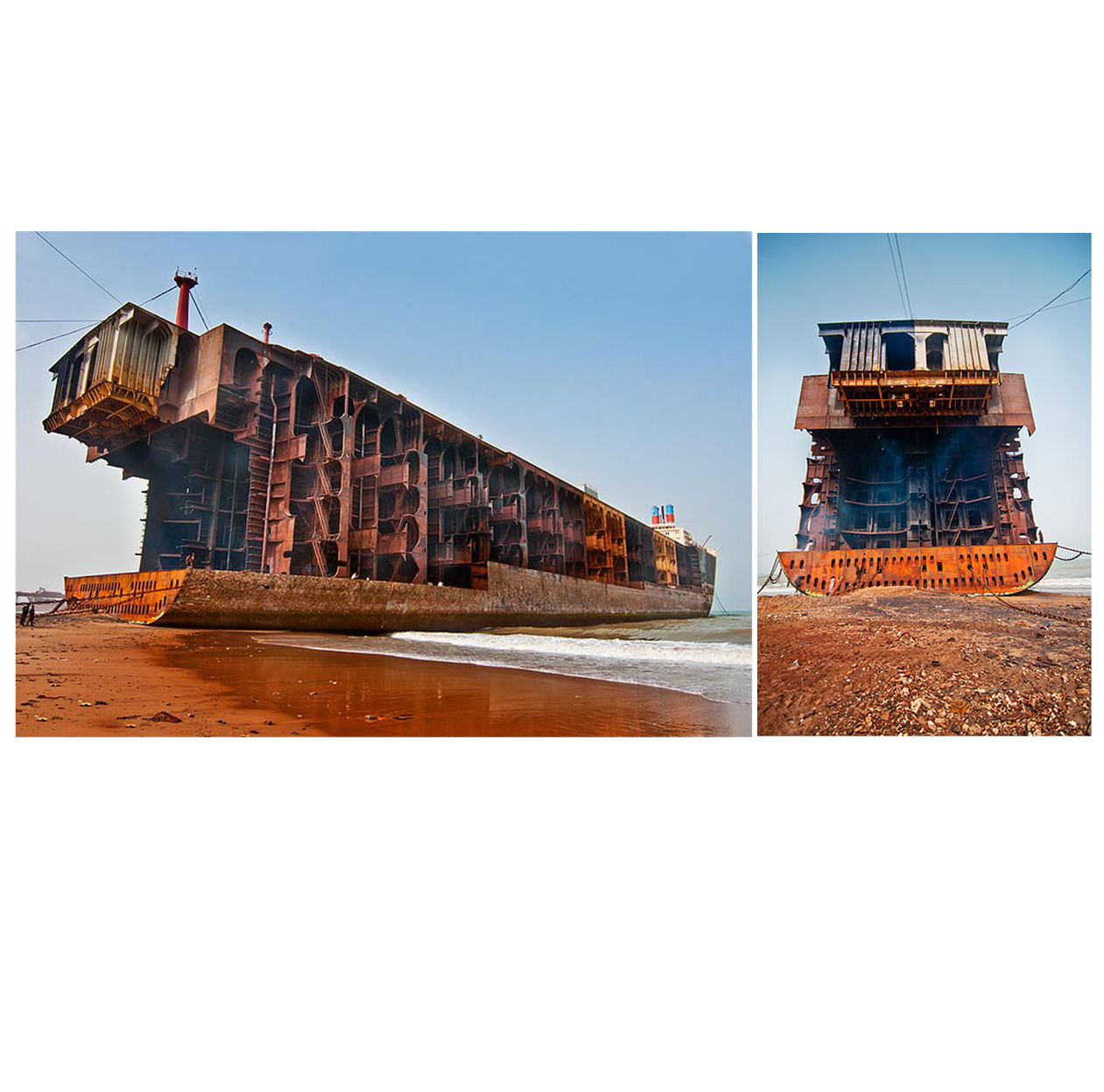 [Oil Tanker in Gandani, Pakistan. Source: dawn.com] Step 01: As an artifact the structure of container ship Shenzhen OOCL (built 2003) was modelled physically at 1:300 and a partial test model at 1:200. Based on the model and a digital model of a bulk carrier, a series of subtractive physical formal studies at 1:200 will be undertaken and mined for their potential reconfigurations of indoor outdoor spaces. The design methodology of cutting and subdivision is informed by the shipbreaking process, where the outer plating is peeled off first before the structure is dismantled by section (the reverse of shipbuilding). Vertical, horizontal, oblique and other ways of sectioning the hull frame will be experimented, as well as different degrees of removal of steel plate. Step 02: Based on digital models of chemical and oil tankers, a series of 1:200 physical models will test the extraction and repositioning of steel parts for building docks and piers as well as related circulation to workers’ housing. Extracted components from container ships, bulkers and tankers will define a library of tools from which the shipbreaking yard can be improved and reconfigured. Step 03: Further development of both types of models gives rise to forms of habitation and workspace and it would then be necessary to consider the urban experience and community life created by the two programs and the in-between space. Refinement of planning in both drawings and 1:500 models probes opportunities in the interconnectedness of programs. Possible speculation of the phasing of such development through a series of plans. Step 04: Plans and sections of redesigned Chittagong shipbreaking yard at 1:1000 and 1:500. Models showing container ship housing (cluster?), shipbreaking piers and other related programs. Bibliography Theory and background research: Le Corbusier. Toward an Architecture. Los Angeles, Calif.: Getty Research Institute, 2007. Abdullah, Hasan Muhammad, M. Golam Mahboob, Mehmuna R. Banu, and Dursun Zafer Seker. “Monitoring the Drastic Growth of Ship Breaking Yards in Sitakunda: A Threat to the Coastal Environment of Bangladesh.” Environmental Monitoring and Assessment: 3839-851. Sarraf, Maria, and Frank Stuer-Lauridsen. “Ship Breaking and Recycling Industry in Bangladesh and Pakistan.” World Bank Report (2010). Zakaria, N. M. Golam, and K. A. Hossain. “Underlying Problems Of Ship Recycling Industries In Bangladesh And Way Forward.” Journal of Mechanical Engineering (2013). Technical building methods: Eyres, David J. Ship Construction. 6th ed. Oxford: Butterworth-Heinemann, 2007.. Mikelis, Nikos E. “A Statistical Overview of Ship Recycling.” WMU Journal of Maritime Affairs: 227-39. Sivaprasad, Kodungallur, and C. G. Nandakumar. “Design for Ship Recycling.” Ships and Offshore Structures: 214-23. Taylor, D. A. Introduction to Marine Engineering. 2nd ed. Oxford: Butterworth Heinemann, 1996. Related projects: Student projects: Thesis about redesigning a ship for low-cost tourism: Diaz, Daniel Hernandez. “Take up the Alexander- travelers hostels and Le Corbusier foundation.” Universidad Politécnica de Madrid. Thesis about reconstructing shipbreaking yard in London: Schofield, Jonathan. “Creative Evolution- Silvertown Ship Breaking Yard.” University of Westminster London UK. Professional projects: Jones, Wes. “PROgram CONtainer system.” Debuted at the Hammer Museum in 1999. Lot-ek. “Mobile Dwelling Unit.” Exhibited at Whitney Museum of American Art, New York, 1999. Ban, Shigeru. “Onagawa Container Temporary Housing.” Onagawa, Miyagi, 2011. |