|
Media Forest- Experiments

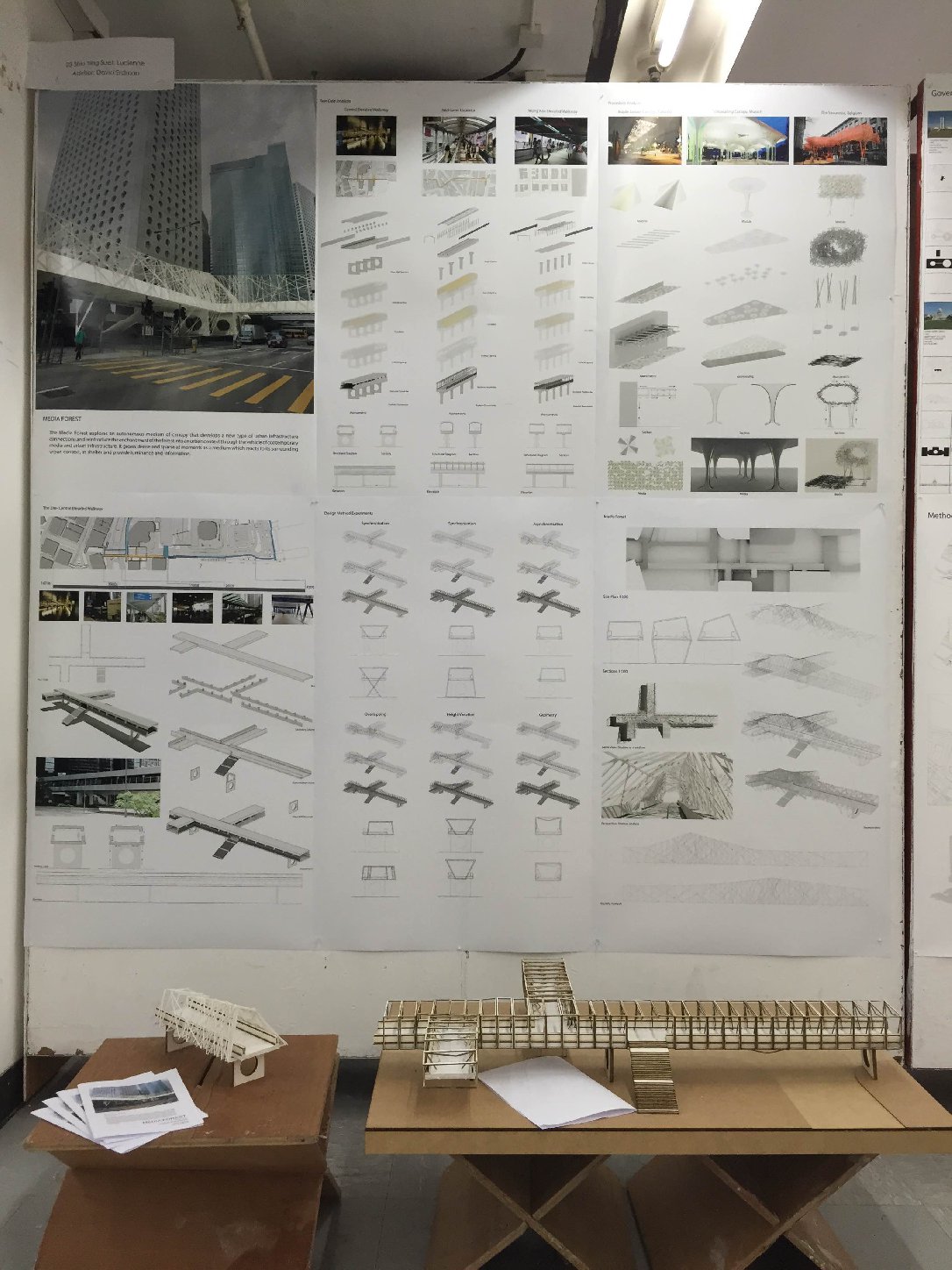
The Media Forest explores an autonomous medium of canopy that develops a new type of urban infrastructure connections and reintroduce the enchantment of the forest into an urban context through the vehicle of contemporary media and urban infrastructure. It grows dense and sparse at moments as a medium which reacts to its surrounding urban context, as shelter and provide luminance and information.
What?
Looking into 3 potential sites: Central Elevated Walkway, Central-mid level escalator and Mongkok Elevated walkway, the Central Elevated Walkway is chosen as a test case due to its iconicity and old age, the thesis rethinks the walkway as a mediated canopy through modern technologies such as interactive lighting systems, otrganic LED and PVC solar collectors. The outcome would be used as a prototype in urban infrastructure linkage for the reinvention of canopies and a new language for signage.
Canopies in Hong Kong are mostly connection that link urban infrastructures within the city, such as escalators and stairs that connect MTR exits. These canopies are mostly designed only for protection of escalators from rain and ease of maintenance and as covers for elevated walkways.
Through the renovation of the Central Elevated Walkway, by designing with its existing super structure, this project will development a new type of canopy; a mediated canopy; that connects different urban infrastructure and links this connection while building characters into the urban context. Through the exploration of the Media Forest, growing as a medium, a structure that grows dense and sparse at different moments; not only does it act as a shelter but also creates a unique urban concept and gives a new perception to the luminance and streetscape of Hong Kong.
Why?
In Hong Kong, narrow streets of urban context are overwhelmed by different scales of signage, they are historically public lighting that contributes to the streetscape. It is to rethink these signs as new kinds of nature within the urban context. These signs are themselves a canopy that dominates the streetscapes and contributes public lighting which forms a particular type of nature produced by architecture.
With the advancement of media technologies nowadays, giving an extension to nature, such technologies contribute to architecture and form a new media membrane- a Media Forest, allowing for diffusion of information within architecture. Humans- being a part of nature lives within the mediated built environment, suited with a media cladded membrane that exchanges information with the outside world- the media canopy.
“A more radical concept of nature might enable us to imagine a significantly modified architectural and social mullein.’- David Gissen.
These infrastructures are built by the government with no involvement with the local designers and architects. These canopies have great potential for local architects to express their vision for the city.
How?
Placing the idea of Media Forest in the urban infrastructure connection in Hong Kong, studying the scale and structure of the canopy; the use of natural light and artificial light, and its effect on the mood and sensibility of the canopy, different geometries and experiments will be tested.
Design Experiments
1. Research on potential test case of walkways in Hong Kong;
2. Research on canopy structures and mediated canopies their interaction with pedestrians;
3. One section of the site is chosen for further structural, geometrical and media experiments; these experiments will then be incorporated to the rest of the site;
4. The treatment of the connecting junction to the other bridges are experimented and tested.
|