Auratecture: the place of sound
|
Auratecture: the place of sound Thesis statement Over the years, music has evolved by its liberation from conventional notations and theoretical structures. The contemporary definition of music has broadened into choreographed sounds within a certain time frame rather than notes of specific pitches. In the same way, architecture no longer is an expression of proportions and harmony. Breaking away from styles and orders, contemporary architecture looks at the relationship between the intention/ concept of the architect and perception/ experience of the audience. Aesthetics of both arts have shifted from the physical concern of harmony and proportions to the sensory and emotional experience. Music is not only about sound and silence, but the experience of affect through the aural sense. Similarly, spaces are not architecture. Architecture is the sensory experience through the composition of solid and void. But how is architecture experienced? Schwarzer (2004) points out that “vision is associated with nerve and muscle movements, and aesthetics are associated with the pleasurable or disagreeable mental sensations caused by those movements. The way the form of a building causes a person to move his eyes or head influences how he feels about the building.” Perception of architecture seems to be dominated by the visual sense. Yet we are unconscious about the fact that the aural sense actually works hand in hand with the visual. Not only can architecture be seen, it can also be heard. While lighting and spatial elements are conceived through the eyes, the enveloping reverberation of a space is communicated through the ears. This thesis experiments the way of recomposing raw sound materials into music (according to the criteria: Extraction of raw materials, Duration, Pattern and Transition), to re-designing architecture through implementation on tram stations. The aim is to create an integration of aural and visual architectural experience. Textual Material of Research Both architectural and musical experiences are linear. Architecture is an artwork in the continuum of space while music is an artwork in the continuum of time.[1] “Music was built out of blocks of time, and these blocks could contain either sound or silence.”[2] Similarly, architecture can be built out of blocks of space, and these blocks could contain either solid or void. Peter Zumthor tried to learn from John Cage as “not a composer who hears music in his mind and attempts to write it down…He works out concepts and structures and then has them performed to find out how they sound.”[3] Further, Zumthor regards contemporary architecture should be as radical as contemporary music in a way that it should not aim at conveying a certain message or symbol. In doing so, curiosity dies and the building is left with its practical usefulness.[4] This parallels with John Cage’s music of non-intention. John Cage uses chance operations to compose his music in the hope of erasing his own tastes and ego, so that sounds can be appreciated as they are. Through researching on how contemporary composers like John Cage view musical composition, I tried to think of what the following characteristics of music mean in architecture: sound, silence, noise and quietness. Sound In the field of music, the characteristics of sound are well-defined. It can be described in terms of rhythm, tempo, dynamics, pitch, texture, articulation, timbre, etc. When we relate these terms with architecture, we can regard sound in architecture as the relatively tangible aspect (or the solid). However, it should be noted that sound may not always be the subject of the artwork. Sometimes the negative of sound (the void) is actually what we want to create (especially in architecture).
Silence Silence does not mean nothingness. I regard the characteristics of sound are also part of the characteristics of silence. Sound can be regarded as the designed, while silence is the undesigned but anticipated. MacLow’s “Total aural situation” represents a system of aural environment made up of concentric spheres with the centre being the individual performer, followed by the whole performance group, larger social group including audience and other performers, the performance space (acoustics), and finally, the rest of the building, the surrounding streets and the city (or rural)[5]. As the aural space is composed of layers, the permeability to an outer layer is silence. Thus, silence in architecture can be achieved through transparency[6] to the relative exterior. Exterior depends on scale (i.e. which layer you are at). It can mean the immediate space surrounding you, the neighbouring room, the building’s own program (which affects how people use, feel about and interact with it), or the physical urban fabric (which affects the views, the environmental sounds, etc.) and social background, etc. Noise Noise can be regarded as sounds coming from an outer sphere in MacLow’s system. When we apply MacLow’s system in architecture, we seem to have drawn segregation between “the interior” and “the exterior”. What should be the strategy to adopt towards “the exterior”? Should we adopt the anthropoemic strategy in screening off “the exterior”, or the anthropophagic strategy to omit “exteriority” by interiorizing it?[7] John Cage describes noise as something disturbing when ignored, but fascinating when paid attention to. When noise is being ignored, the anthropoemic strategy is adopted. On the other hand, when noise is paid attention to, the anthropophagic strategy is adopted, and the boundary is silenced. Hence, noise is a result of silence. Only when there is silence, noise is given the opportunity to be noticed and appreciated. Quietness Quietness is the use of the anthropophagic strategy. This can be expressed in the modesty/ subtlety of the interior relative to its exterior. Concluding from the above, we can categorize architecture into two aspects – sound and silence. The Architecture of Sound is anthropoemic. It is an object that stands on its own. The Parthenon and other classical architecture are examples. The Architecture of Silence is anthropophagic. It is merged into its exterior and represents only part of the continuum of space. Quietness can be a means to achieve the Architecture of Silence. As discussed earlier, silence in architecture can be achieved through transparency. Transparency in architecture can be primarily categorized in terms of visual, aural and physical aspects. However, what governs our decision on which aspect is to be transparent or opaque relative to each other?
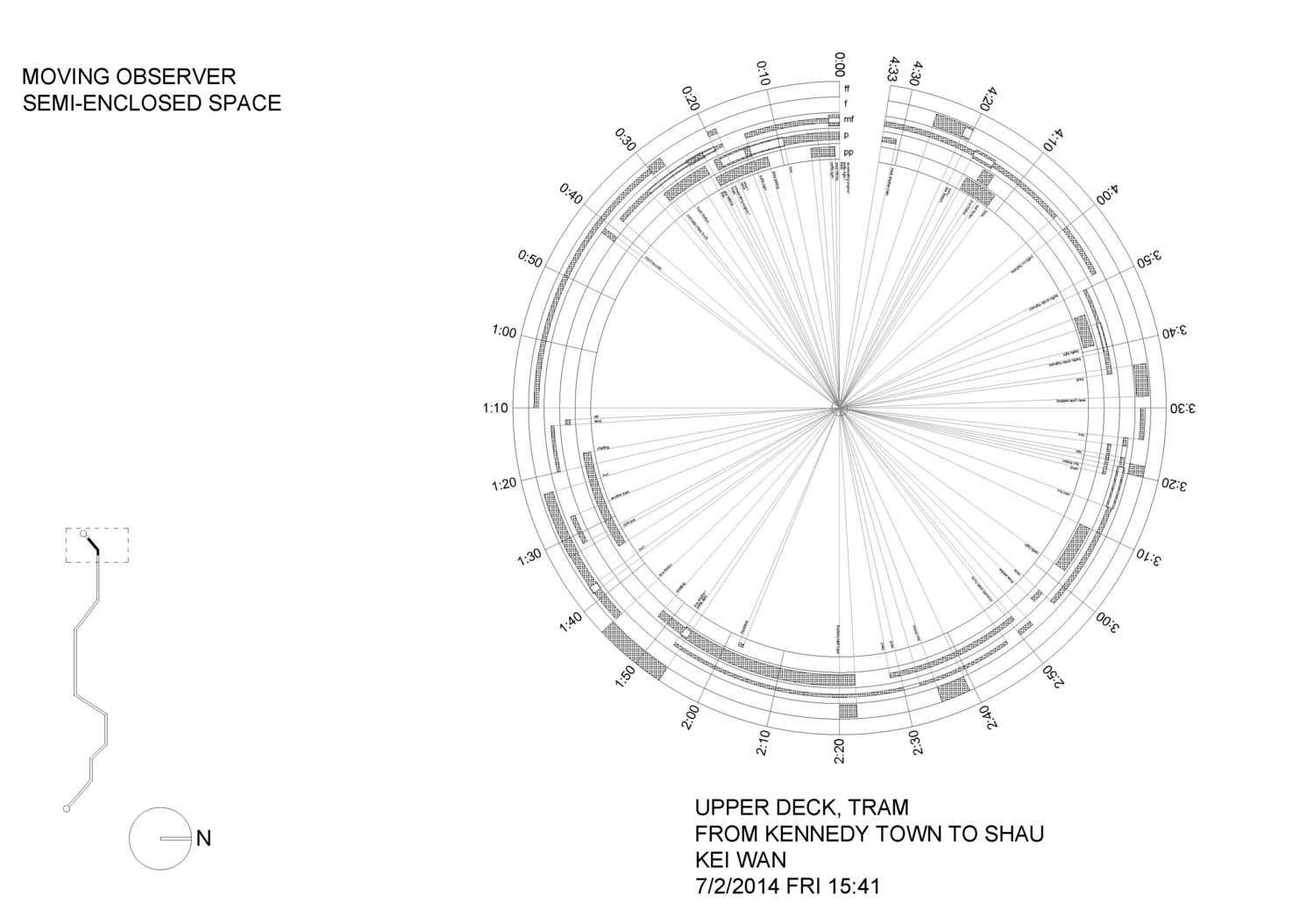
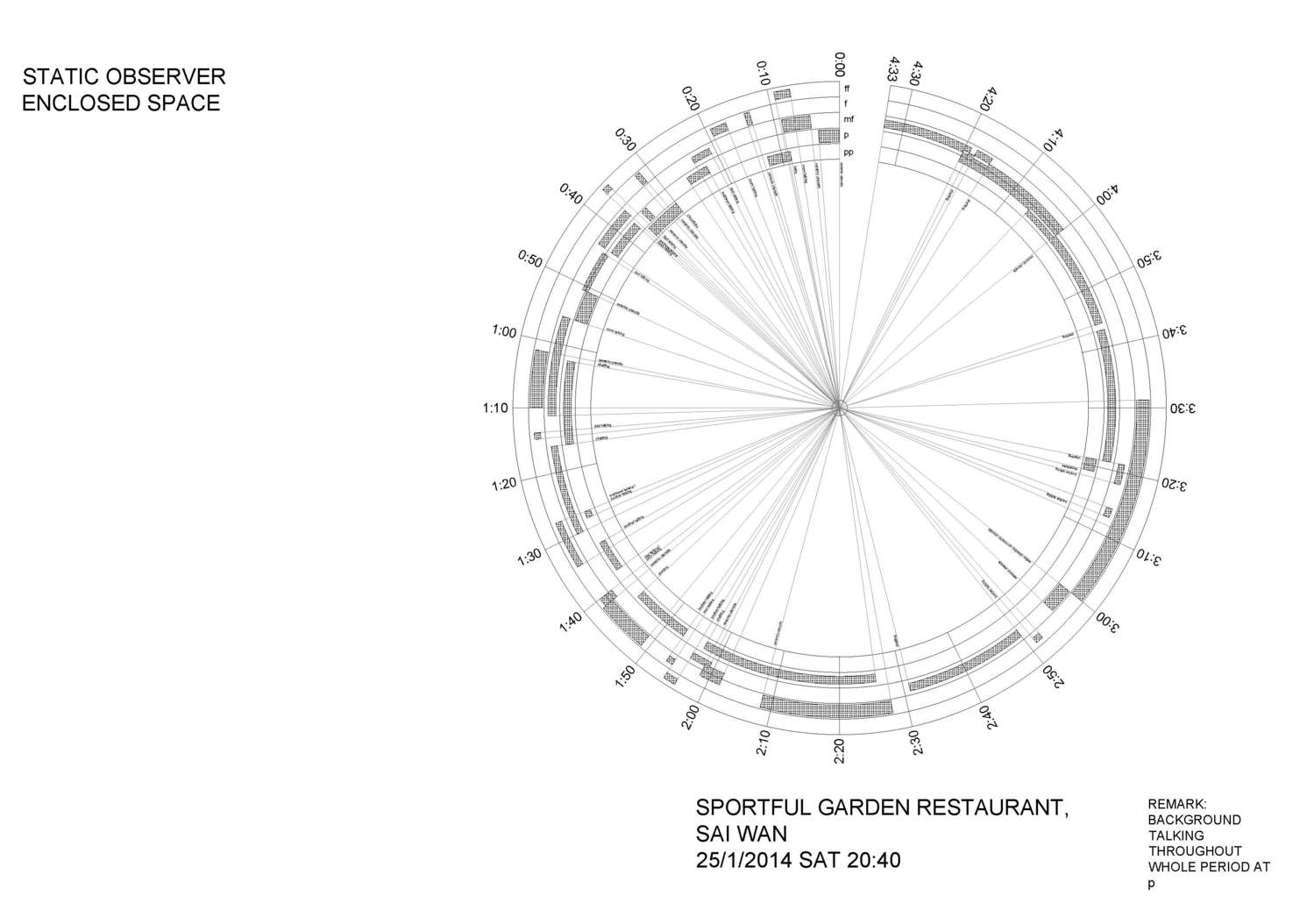
Project Description – Design Research The project is an architectural design in the urban environment using sound as a driving force. It is done through extracting sound information from the environment and in turn using that information to recreate the environment. A few sites along the tram line were picked and visited at different times of the day. The observer moved along a designated route on the upper deck of a tram so that environmental sound is recorded for a duration of 4’33”. Sound mappings were produced.
Architecture learning from musical composition A 1-minute short film is made by choreographing sound samples, together with their corresponding video footages, recorded from the urban area along the tram route. The aim of the short movie is to explore and extract possible architectural design methodology from musical composition: A. Extraction of raw materials Audio information of the urban environment is extracted and filtered to form the raw materials for the composition. Sound samples are selected according to a few criteria. Firstly, identifiable sounds are give priority, which become the melody of a particular passage. The ambient sounds that are less recognizable become the accompaniment, thereby setting a hierarchy between different kinds of sounds. Secondly, the quality of sound in space (e.g. an open space leads to diffused sounds while a closed/ contained space gives more echoes) is considered when creating overlapping layers of sounds and when a passage transits to another. This can create sound-spaces (the virtual space created when listening to the composition) of unification or contradiction. B. Duration of each sound/ passage The duration of each sound affects the rhythm of the particular passage. In turn, the duration of these passages affect the rhythm of the whole composition. The interplay of short and long sounds also affects the texture of the overall sound experience. C. Repetition/ Pattern (Motif?) The composition begins with a recurring rhythmic pattern, upon which other passages are based. The recurring pattern acts as the foundation of the piece, while layers of sounds are added within the time frame set by the period of repetition. D. Transition The overall structure of the composition is thought as gradually ascending to a climax and then descending from the highest point. However, within this general up and down, there are subsidiary ups and downs when the piece is divided into smaller parts.
Tram stations design 3 sites (admiralty, sai wan, happy valley) are picked where tram station designs are to be implemented. The sites are studied according to various parameters such as movement, functional needs and visibility so that a general site-specific set up is created for each site. Sound deformation is then applied according to the properties of environmental sound sources, such as volume, speed of the sources and the desirability of those sources to be heard at the stations.
Progress Report 1. First review The circular mappings should be drawn linear instead and overly abstract. They should be directly overlaid onto the physical environment. The reference to John Cage’s 4’33” was unclear. It has to be linked to the context in which the piece was composed. In the case of 4’33”, it was the break between classical and contemporary music and implied a brand new interpretation/ definition of music. However this thesis does not have a revolutionary theory as John Cage did with his work, and it is also difficult to achieve. The only new idea is that the design of architecture/ urban environment seldom used acoustics/ sound as a driving force. This can be further developed. The parameters taken in the sound mappings are also too simplistic. More parameters have to be incorporated in the project and they need to be clearly identified and specified. Sound should be looked at in two aspects: 1. foresee a kind of sound equipment that will contribute to architectural experience 2. take sound as music and uses this as an intellectual methodology. Is sound a subject or an agent? Think about cinematic architecture as there is certain operational methodology. Design should also deal with the time dimension. The project is still vague. The product should be identified first before a research direction can be identified. A suggestion of project is to create a prototype of sound device that can be applied to the urban environment (e.g. along a street/ tramway) so that a musical performance can be held. 2. Second review -presentation too static -architecture should be a representation of the dynamic sound environment, rather than a frozen moment of sound 3. Third review -methodology of form generation should be presented clearly -hard to verify the sound performance of the model References & Bibliography
[1] Galia Hanoch-Roe, ‘Unfolding Space through Time: Dialogues of Linearity and Modularity in Musical and Architectural Scores’, In the Place of Sound [2] James Pritchett, ‘What silence taught John Cage: The story of 4’33’’’ [3] Peter Zumthor, Thinking Architecture, p.29. [4] Ditto, p. 13 [5] John Cage, ‘Music and particularly silence in the work of Jackson MacLow’, John Cage, Writer : Previously Uncollected Pieces, Limelight Editions 2004, p.151-152. [6] Branden W. Joseph , ‘John Cage and the architecture of Silence’, October [7] Rolland Munro, ‘The consumption of time and space: Utopias and the English romantic garden’ |