de.Void- (In) Between Void of Articulation and Void by Destruction
|
// devoid – empty, lacking, having the desire to be filled
CONCEPTION OF VOID Void exists in both the literal and abstract meaning. The physicality of presence is experienced by the absence, and vice versa. Its nature of emptiness and nothingness always leaves space for interpretation and imagination. The thesis tries to explore the concept of ‘void’ in relation to memory, space and urbanism, its social-spatial implication, and examine how the ‘void’ can be conceptualized, spatialized, materialized and symbolized to address the issue of memory and identity in the passage of time. Berlin, with its dramatic historical setting, provides a unique context to contemplate the alternative notion of ‘void’ in contemporary cities and explore its position in re-stitching the past with future and the city fabrics.
CONTEXT OF VOID “The ‘void’ may have been filled physically but the memory and history will always linger” by Andreas Huyssen Berlin is a fragmented city to the eyes of many, even up to now almost 25 years after the fall of the Berlin Wall. The invisible line running across the city has never disappeared in the memory of Berliners and tourists, despite the demolition of Wall and commencement of large scale developments to fill the voids. This provokes a question: If our memory of the invisible line and associated voids can never be erased despite any efforts to remove them by physical means, why not we turn the then Death Strip (void left by destruction) to a physical void which is constructed out of architectural articulation (void of articulation)?
MATERIALIZATION OF VOID The proposal is to convert portions of the then Death Strip into a physical void cutting down into the ground, reminiscing people’s psychological idea of ‘void’. The invisible line no longer exists mentally in the minds of people. It reappears on map again by reinventing its form from the former Wall of Horror standing above ground to a partially underground cavity for both memory and aspiration. By excavation of ground to create a landscape constituting various voids and levels, it evokes a romantic notion that the process of excavation analogizes the journey of a man searching for his memory of the past. [Walter Benjamin, Excavation and Memory] This analogy is translated into architecture by carving out space to create architecture such that one is walking down into the ‘void of articulation’ for self-reflection and redemption to fill up his ‘void of memory’. The proposal positions itself in various ambiguity: By materialization of the ‘void’ constituting different levels, the space created lies at a place in between East and West (former divided ideologies), underground and aboveground (former reunified utopia constructed by U-Bahn and the hostile world aboveground). This space narrates the course of history by linking the past to present. In the dilemma between conservation of border strip and relics as monuments (nostalgia) and destruction of them to make way for developments ignorant of history (amnesia), the proposal situates in between remembering and forgetting. The fragmented history is preserved by materialization of the ‘void’ as monument rather than keeping the actual relics. With the programs filling in the subterranean ‘void’ as social space, the linear Death Strip transforms into a hybrid excavated landscape incorporating programs and circulations, embracing the past while in hope of an optimistic and diversified future.
[Methodology] 3 different ‘voids’ are juxtaposed for analysis and investigation: Void of Memory – an intangible perception existed in minds as a result of the traumatic history. Void left by Destruction – a physical empty space in the urban fabrics as fragments and ruins. Void created of Articulation – architecture using ‘solid-void’ as spatial articulation to respond to above ‘voids’
The history of Berlin has been written, erased and rewritten repeatedly over time. This inspires the overlaying and decomposition technique in research/design methodology. – Superimposition and collages between different means, such as photos, maps and film shots, would be used to reveal the changing memory of the city and extract spatial quality of the ‘void’ over time. – The intangible relationship between monuments and Death Strip will be abstracted and spatialized using superimposition, mapping and modeling. This abstraction then acts as a driving force to deform the ‘void’ as architecture. The design process involves projection of the intangible urban relationship to the site and carving out space to create architecture characterized by figurative signs based on design operations, such as subtraction and addition. It registers memory and responds to urban relationship by deconstructing visual and urban connectivity, elements of light and shadow, solid and void. – ‘Solid-void’ language will be used as spatial and compositional configuration in the design process to create different space. Casting models will be made to test the various configurations, like solid-void inversion and different disposition of deformation.
[Annotated Bibliography]
Raimund Abraham, ‘Church on the Berlin Wall’, 1982 The symbolism of the project and his design methodology of carving out space characterized by marked graphic and figurative signs give inspiration to the project. Andreas Huyssen, ‘The Voids of Berlin’, 1997 The narration of the city void and its association to memory and city development gives inspiration and sets historical and theoretical background of the thesis
Daniel Libeskind, ‘Berlin Jewish Museum’ , 2001 The fragmented deconstruction and ‘void’ space in the museum reflects the linkage between history and architecture. This is one of the precedent buildings to investigate the relationship between the memory and space. Peter Eisenmen, ‘Memorial to the Murdered Jews of Europe’, 2005 Minimalist concept is adopted for public memorial sites. The ultimate abstraction raises questions and challenges for people to rethink the public space for memorial. Aldo Rossi, ‘An Analogical Architecture’ , 1966 The exploration of analogy as a design methodology to investigate the intangible relationships between elements of a city provides inspiration to the analogical aspect of the proposal. Walter Benjamin, ‘ Excavation and Memory’ , 1932 The analogy between excavation and search of memory provides the theoretical background of the project Wim Wenders, ‘Wings of Desire’, 1987 The film captures the isolation of Berlin before the fall of Wall and provides a source to document the city for research. The scene in which the old man fails to find the Potsdamer Platz in his memory but only the empty wasteland carries multiple meaning. This scene evokes me to rethink the effect of ‘void’ on psychological and urban aspects. Rem Koolhaas, Madelon Vreisendorp, Elia Zenghelis, and Zoe Zenghelis, ‘Exodus or the Voluntary Prisoners of Architecture’, 1972 The ironic statement on edge and void based on Berlin Wall provokes thoughts on the alternative meaning of these spaces in contemporary city. Lebbeus Woods, ‘Underground Berlin’, 1988 The idea on the ambiguity between aboveground and underground of the proposal makes its reference to this project in which a unified utopian world is constructed underground before the fall of the Wall.
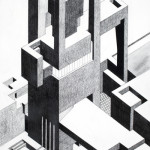
Subterranea drawing by Rick Gooding
|




One Comment
Leave a Reply
You must be logged in to post a comment.
I need to ask why people wanna have a crater that runs through their city. to be reminded? to play with the word “void”? If I am allowed to speak up as a German, loving Berlin and my country, I do not know why and what this crater would offer to the city. Berlin is a city of voids, voids exist between many parts – where the previous area of the wall is only one of many. That is not an issue of/for Berlin.