ECHOS OF ARCHETYPES
|
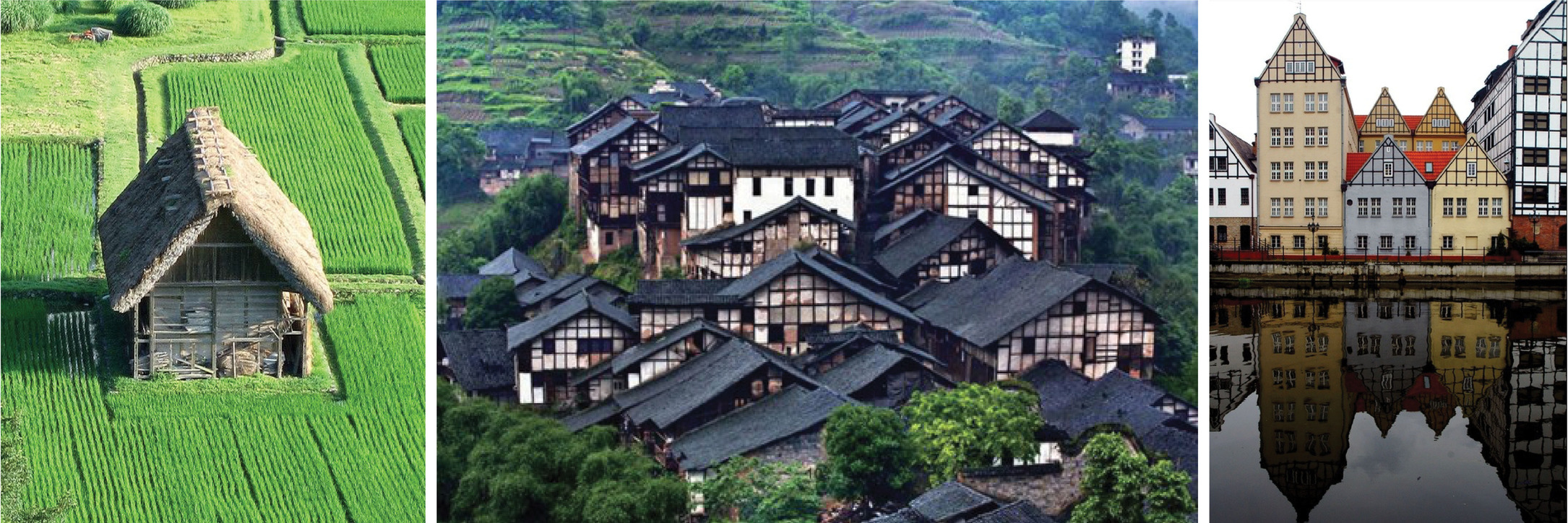
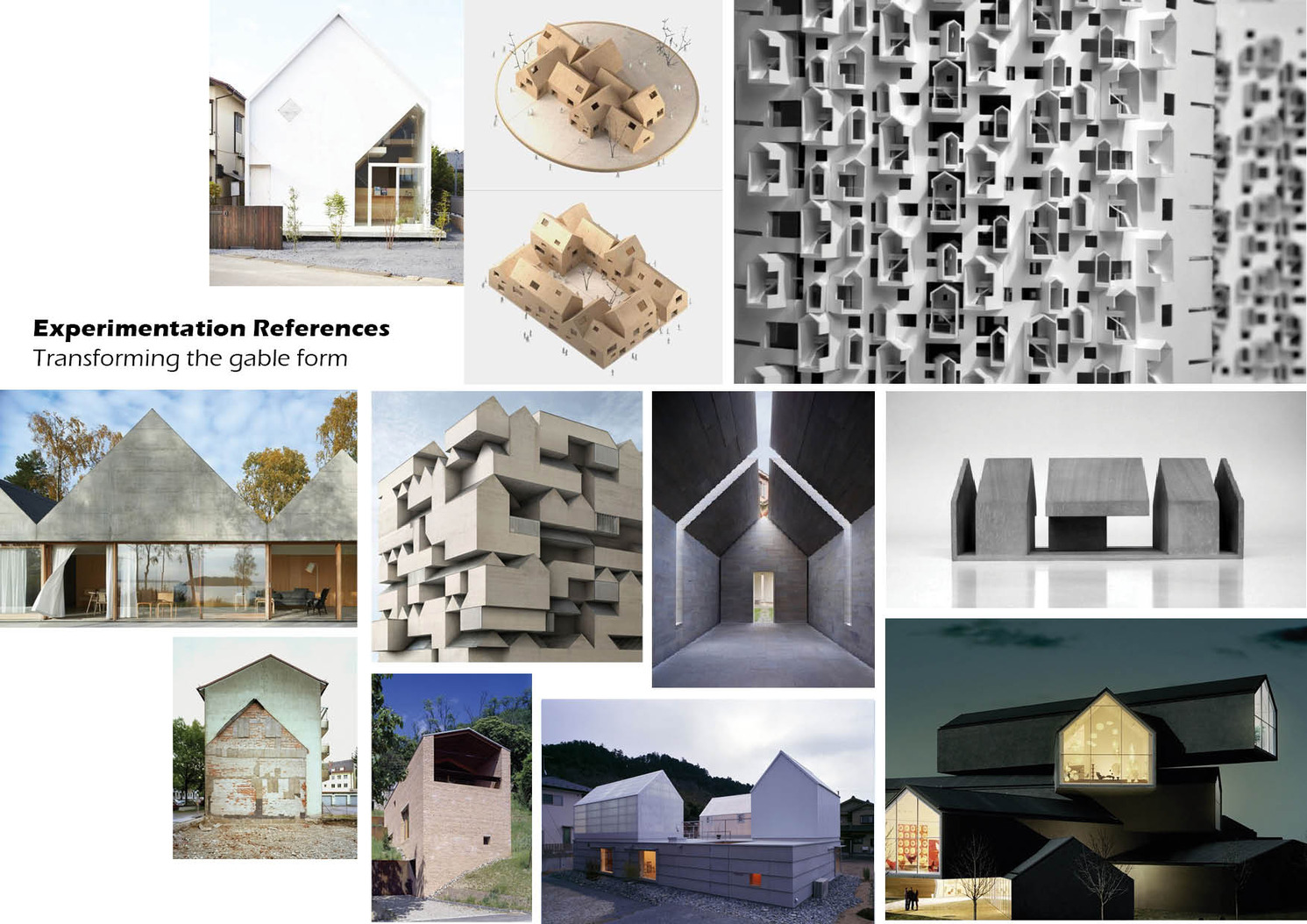
STATEMENT: “Archetypes are Universal, archaic patterns and images derive from the collective unconscious. Archetypes are autonomous and hidden forms which are transformed once they enter consciousness and are given particular expression by individuals and their cultures.” —- Carl Gustav Jung  Most typological of architectural elements,the gable house…that most people at a young age associate with house and home. Gable form as archetype. Archetype as Typological Basis for Variations Archetype can be considered as an image abstracting the commonality of certain type of architecture has been built in our understanding of this type. It is usually established by its structural/ functional accomplishment and the image is consolidated in our mind through centuries of reproducing. The forms established our understanding of architecture by shared experience can be called archetypes. The original Greek meaning of the word archetype is “first form” as it exists as a basis for all later variations and combinations. Archetype as Carrier of Meanings Archetype is the unity of form and notion.The accumulation of shared experience associate certain forms with meanings, in which way we ‘use’ them psychologically prior to using them physically. The form once influenced by functional considerations have been endowed with substantial symbolic content. The close dialogue with psyche makes the archetypal forms as carriers of meanings. The thesis will investigate the duality of archetype as a carrier of its original meaning and the potential meanings superimposed by logical translation.
PROJECT DESCRIPTION: “Architecture, however — the world of objects created by architecture — is not only described by types, it is also produced through them… Architect is initially trapped by type because it is the way he knows. Later he can act on it; he can destroy it, transform it, respect it. But he start from type.” —- Rafael Moneo Hypothesis: Typology as Instrument Working on the hypothesis that behind many forms in history lies a simple set of archetypes which exists as the basis for our understanding of architecture, the thesis argues that reviewing on the pre-exist forms is one of the motivation driving evolution of architecture. New spacial patterns can be provoked by conscious re-examination on the fundamentals of the archetypes. By translating the original meaning of the abstracted forms, a structural/spatial alternative can be achieved in a comprehensive architectural design. Reflection of Type and Typology: Against Single Classification Principle of Type The thesis has an attempt to renew the critical architecture discourses on type and typology. The question of a typology is a historical basis for inquiry into the essence of architecture.
For the multiple forces in the generation of architecture including to against gravity, to protect from environment, to contain human activities, the intentions to search for a single classification principle to identify types in historical discourses seems to be problematic. And it always leads to an obscure notion eventually that cannot classify architecture into types successfully. Type is identified by recognizing the commonalities of architecture. The commonalities can be examined from different point of views. In this way, architecture can be classified parallelly by the type of structure, type of use, type of organization, or type of shape. The classification can not be reduced to each other, but all related to the nature of architecture. The proper association with the mentioned TYPES produces a coherent form. Such association is influenced by the circumstance of time and place, and through years of reproduction, gives rise to a dominant image eventually. Such image influence our understanding of architecture. Methodology: Operation within Common Framework My thesis will focus on the diagrammatic translation on the images as architype. Since the dominant image might not be the only proper solution, by examine the ‘Type’ via different point views, an alternative association may provide an spatial/structural alternative within such an image or across several. Ref. Both the following texts demonstrated the considerable instrumental capacity of typology to serve as the basis for architectural experimentation.
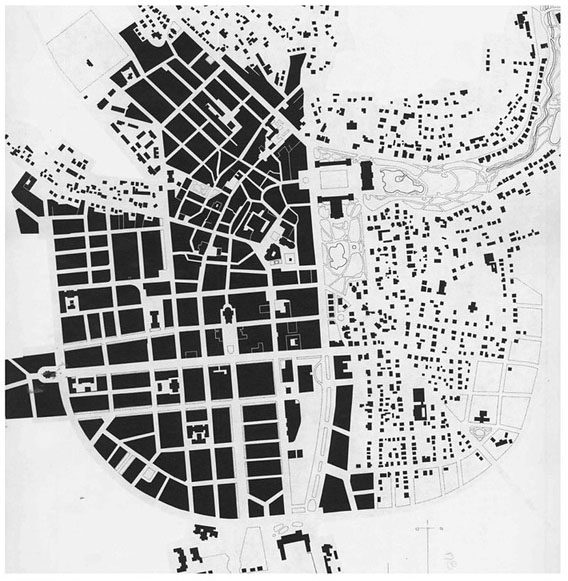
Collage City, by Colin Rowe and Fred Koetter,pursued a typological assessment of the classical versus the modernist city along a traditional, planimetric form of analysis focusing on Nolli’s Rome and Le Corbusier’s Paris.
Rem Koolhaas’s Delirious New York, presented a deeply typological assessment of modernism in the form of a distinctive sectional reading of the generic urban block comprising the Manhattan grid.
OUTLINE OF RESEARCH FRAMEWORK: 1. Type and Typology in Architectural Discourses 2. Archetype as carrier of its original meaning Motif- Theme : pick archetypes and study of the implication of the forms. Various Expressions of the archetypes are given by individual and culture as response to material , technics, aesthetic, etc.
|