Kabuki and surrealism
|
Kabuki and surrealism Why- Thesis Statement Thesis statement My thesis try to explore how can we preserve the intangible culture heritage by using new means of architectural devices. Under globalization and political reasons, Tokyo has faced various cultural invasions from its neighbor South Korea and “big brother” America. The traditional Kabuki, the singing and dancing performance that originated in Edo period(1600-1868), has been vanishing in the contemporary society of Tokyo. The Kabuki is a listed UNESCO intangible cultural heritage. In 2010,a traditional kabuki theatre in Ginza, Kabukiza, has been torn down and replaced by a 49-storey office building. Not to mention there is an urgent call for architecture to intervene spatially to revive this lost traditions, it is also important that architecture has to retrieve its role as a criticism or reflections to prompt people to rethink about their culture, traditions and city.
(Kabukiza in Ginza, Tokyo) My thesis tries to challenge the notion of surrealism in architecture and its modern application in the cultural and society context in Japan. Architecture nowadays has lost its criticality. It is a global phenomenon that architecture has been rendered similar, rational, mundane and come as expected in terms of programs and forms under the capitalistic society. Architecture has gradually lost its power to criticize the society. When built projects are optimized to last and function for decades, architecture is often underestimated as a super slow media as a social critic to an ever-changing city like Tokyo.
Dressed in black and white formal codes, office worker commuting in metros in Tokyo look like robots delivered by cargos. Under the education of Japanese cultural and societal values, Japanese are taught in the primary rule of manner to not to disturb others in public[2]. Japanese behaviors in public are mannered, rational and highly restrictive and suppressive. When the city and people inside it are so rational and boring, I see this as an opportunity for architecture to create surprising and surreal scenarios in public to provoke critical thinking.
(a typical scenario inside Tokyo metro) What- Description of Project Intended to Test the Thesis Statement My thesis will try to explore the use of surrealism as propaganda to arouse interest, controversies and rethinking of the society. In the 18th century, artist Piransei presented his fantasies of the dark Prisons with the overlay of real architectural Roman carcasses[3]. The art theory of architectural capriccio played an important role in influencing the Surrealist movement in the 1920s. The Surrealists aim to resolve the contradictory conditions between dreams and reality[4]. In Delirious New York, Rem Koolhaas propose the Paranoid-Critical Method[5] as an experimental process to redefine the root in reality to intrigue the people and provoke criticality. Aforementioned, when the architecture and people of Tokyo are considered as rational buildings and programmed robots, capriccio drawings or surrealist art appreciate autonomous imagination, irrationality and unexpected juxtapositions with the reality. What if the notion of surrealism is manifested in architecture and the most traditional kabuki Japanese culture to be used as a form of criticism to the restrictive structures, rules, traditions and social norms of the contemporary society of Tokyo?
(Piransei: The ImaginaryPrisons) To revive the lost Kabuki culture under the notion of surrealism, my thesis will investigate the design approach of unexpected programmatic layering and juxtaposition in a seemingly irrational way. The research outcome will be a complete set of spatial design principles of how Kabuki operates. With this set of principles, I could apply them to the later stage of design – either a reinterpretation of contemporary pop-up urban Kabuki devices or a translation into other types of program e.g. office plan etc.
In the case of reinterpretation of Kabuki theatre, pop-up kabuki devices are proposed at extraordinary places to create surreal scenarios. (Say, kabuki at back staircase of office building / go-around sushi fast consumer stores / the busy crossroad of Shibuya / one metro car) A typical play in theatre, which composed of the acting of performers and the viewing of audience, portray the surreal and fictional scenarios in itself. The Japanese theatre, kabuki, comes from the term kabuku (out of the ordinary) even implies an eccentric and bizarre theatre.
(A ukiyo drawing of Kabuki Theatre – Shibai Ukie) When kabuki has the nature of surreal in itself, over layering it on top of other unexpected programs and places will intensify the power of surreal in terms of multi and contradictory meanings, spatial settings, programs, users e.t.c. With the synergistic surreal effect by kabuki in various contradictory spatial settings, my thesis will explore the use of instantaneous and mobile architectural devices to arouse interest and prompt the rethinking of people.
How- Outline of Research Methods [1] Background Research : 1. On Globalization – what leads to the lost culture in Japan now Globalization is not from the 21st century. Its birth can be traced back to the times after World War II. It can be said that the history and policies in period of time play a determining role in shaping the world we are living in now – the diminishing of local cultures happening in Japan and other parts of world are not accidental. After WWII, America deployed its massive soft power invasion to the rest of the world in the period of Cold War, dated from 1947-1991, majorly to resist the Soviet communist power. The Marshall plan[6], a recovery program aiming to aid the recovery of European countries and promote the cross-national trade, speeds up the globalization through increased global economic and cultural exchanges. While Japan is out of the scope of the Marshall plan, the amount of aid it received from the States is $2.44 billion – the highest amount (40% of the total aid to Asian countries) among all Asian countries. While some scholars attributed the peace and stability of the world after WWII to the Marshall plan, on the other hand, this ambitious plan and capitalistic idea faced several resistances on the fear of local cultural erosion. 2. On cultural takeover in the world – oppositions and cultural protection of other countries v.s. Japanese reaction & reasons behind France is one of the countries that demonstrated its rejections on anti-globalization, in particular the Americanization. From the article of “Coca-Cola and the Cold War: The French Face Americanization, 1948-1953” [7], the cola-cola is seen as an universal object that affront to the French culture. In 1949, French communists even attempted to prohibit the sale of coca-cola in France[8]. Other countries in the world, such as Italy, Spain, Brazil etc. , also imposed quotas on the import of American culture to their own countries. In 2005, UNESCO raised their concerns on protection of local cultures by passing the Convention on the Protection and Promotion of the Diversity of Cultural Expressions. The United States claimed that the protectionism of such cultural exception will harm global trade. Alongside the States, Japan opposed the imposition of such convention too. It could be explained by the intertwined economic and political relationship between the two countries after WWII, with each of them considering each other as the most important ally in the world. 3. On preservation of UNESCO intangible cultural heritage – Kabuki in Japan With strong political and economic reasons, Japan had no choices but to rely heavily on its powerful ally of America. Infusion of American culture is not an option. The same situation applies to many other countries in the world. How should cities, under the dilemma, react to the cultural takeover? How can architecture regain its power to preserve the intangible culture of the city? 4. On preservation of other forms of UNESCO intangible cultural heritage and their implementation
[2] Research in Kabuki & Theatre: 1. The History of Kabuki and its relation to the culture and history on Japan 2. The form of existence of Kabuki as Japanese Theatre and its distributions 3. The spatial setting of Kabuki Theatre and its evolution over time 4. Different types of theatre (western) v.s. Kabuki theatre When western theatres are majorly “shoebox” theatres, Kabuki theatre is one that the stage and the extended walkway are surrounded by people from all sides[9].. The audiences can enjoy the stage from different angles while they are also able to look at how other audiences react. The audiences are also actors at the same time.
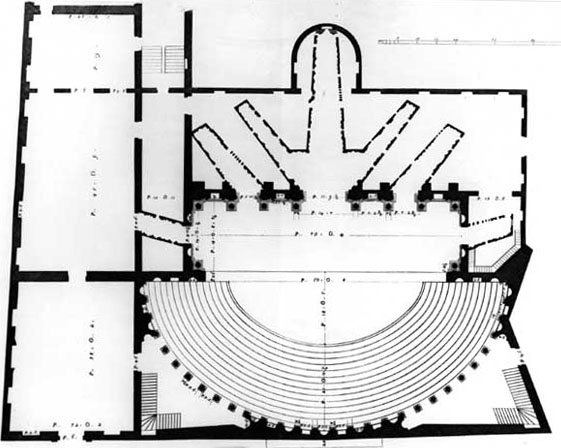
5. The Total Theatre by Gropius and the Teatro Olimpico by Palladio As a criticism to the generic shoebox theatres, Gropius created the Total Theatre, which the theatre rotate to allow different spatial settings. Palladio realize typical shoebox theatres do not allow the audiences at different locations will view the same stage differently. Therefore, he created the 3D stage setting to utilize the perspective and view angle between the audiences and the stage. All these are interesting theatre theories as input for analyzing the Kabuki theatres.
(Palladio: Teatro Olimpico)
(Walter Gropius: The Total Theatre) 6. Representation of Kabuki as in ukiyo drawings (浮世絵) Originated in the late 17th century, Ukiyo drawings are a special type of drawings to represent. The color print ukiyo showing the Kabuki theatre in the reference is a combination of different perspectives. The drawing, in itself, represents how the Kabuki theatre can be read inside – the drawing as a combination of the perception by multiple audiences at different locations inside the theatre.
(A ukiyo drawing of Kabuki Theatre)
How- Outline of Design Methods [3] Operational methodology – Surrealism : 1. Paranoid-Critical Method (PCM) While Dali, in the late twenties, injects the method of PCM to surrealism, Rem Koolhaas proposed to use paranoid to create the criticality[5].. -Motto of the Paranoid-Critical Method (PCM): “The Conquest of the Irrational” -“Modern architecture is invariably presented as a last-minute opportunity for redemption, an urgent invitation to share the paranoiac thesis that a calamity will wipe out that unwise part of mankind that clings to old forms of habitation and urban coexistence” (with reference to The Noah’s Ark) -Reinforced concrete as an extremely surreal material to operate – a transposition of Dali’s dream of photographing Mary’s Ascension “concrete- permanent life on earth, un undeniable reality” 2. Form of surrealism as manifested in art and architecture Piranesi revolutionized the stylistic canons for the representation of prisons – an iron cage, or a cell surrounded by massive bars – and expressed the deep angst that stems from seeing life as an unstoppable, eternal return of pain and evil[4].. 3. Surrealism as manifested in movies To create and experience a surreal world, one could easily possibly link it to the movie world for the imaginary. Japanese push the imaginary world to another extreme by creating anime movies. My thesis could use movies to analysis how it creates the surreal and any spatial principles that it operates with. Possible movies: Paprika, Millennium Actress, Inception [movie: 2,3,4]. [4] Design:
Bibliography
Movie / Anime movie
|