(Re)Appropriation of Public Space : Transgressing the Residue
|
LOOSE SPACE ALONG THE FLOW In between our densely built city space, there are many different transitional spaces distinguishing inside from outside and mediating people’s passage and circulation. They provide us with means of prompt and efficient transportation while we may not be even aware of the presence and proximity to the surrounding environment. In fact, there is a staggering proportion of empty spaces that are left over, neglected and fallen into the state of indeterminacy. The rush and flow in city overlap with the emptiness of the residual space. It is the looseness of these residual spaces that allows an open interpretation by the general public, and more possibility and diversity could be provoked out of these spaces.
A CONFINED BOUNDARY At the same, the current approach towards the city development is overwhelmed with meticulous demarcation and rigid order. Every space needs to be accurately defined with an initial purpose and a predictable outcome, placing people in the role of passive consumer of the end products by the architects rather than active creators or participants of city spaces. It further rigidifies the boundary between programs, circulation and residual spaces.
URBAN APPROPRIATION Therefore, the issue specifically addressed in this thesis is the conflicting states between flow and residue as well as precise control and simultaneous response. By injecting architectural interventions to alter the ambience of the environment, people’s preset preconception to the environment could be destabilized and induced to transgress the place, thus a unique interpretation of the spaces would be emerged and truly reflected.
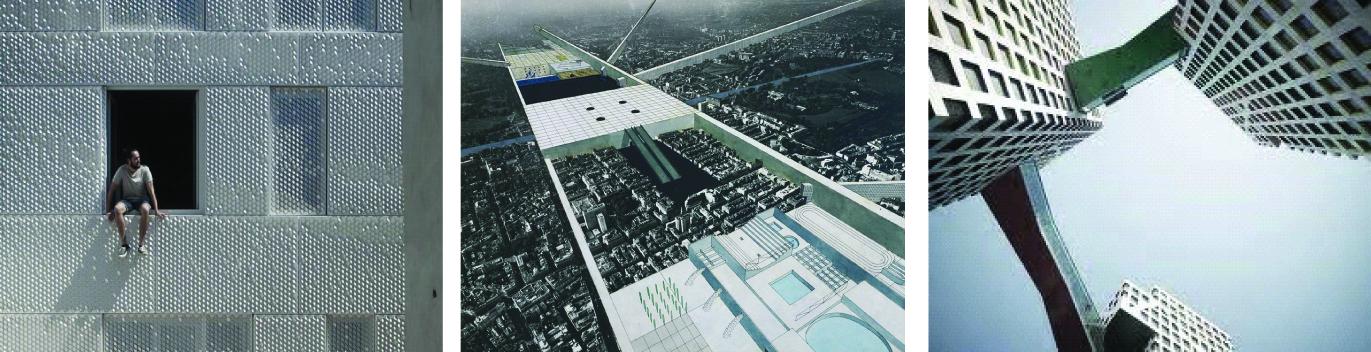
TRANSGRESSING THE RESIDUE Central, as one testing ground, is a heterogeneous place with rapid urban organization flowing above the grounds. Its iconic network of infrastructure generates extensive flow of circulation. People are always attracted by the vibrant lifestyle of Central; whereas the hidden layer of public spaces on ground are always neglected.
The project aims to set up an ambiguous boundary prototype which could soften the rigidity of the city boundaries, and hence revitalize the residual spaces and establish a urban network. The project also attempts to set up a dialogue of how a carefully designed built environment could affect one’s perception to boundary and transition.
METHODOLOGY The research is structured into 3 levels: Interfaces of boundary prototype This is to study how the reacting interfaces of the prototype to two defined programs could be enhanced through visual contact to environment which affects one’s perception to sense of enclosure. – Transparency – Permeability – Visual linkage Sequential narrative This is to study how one could experience the spatial progression inside the prototype which affects his perception to distance and program organization. – Focal point – Detouring – Landscaping – Program injection Urban connectivity This is to study how the boundary prototype can be adopted in the city scale which can be further linked up as an architectural journey through the city fabrics, and initiating more transgressive behaviors in the residual spaces. – City networking – Reform of the role of transitional space
REFERENCES & BIBLIOGRAPHY 1. Junk Space, Rem Koolhaas, 2006 “If space-junk is the human debris that litters the universe, junk-space is the residue mankind leaves on the planet…” 2. The Social Life of Small Urban Spaces, Whyte, W.H., 1980 “A good plaza starts at the street corner. If it’s a busy corner, it has a brisk social life of its own. People will not just be waiting there for the light to change. Some will be fixed in conversation; others in some phase of a prolonged goodbye. If there’s a vendor at the corner, people will cluster around him, and there will be considerable two-way traffic back and forth between plaza and corner…” 3. Bloodstained Architecture, Mark Wigley, 2002 “ Truly public space would defy categorization. Indeed, it would not even be recognizable as a space. Its openness to heterogeneous social transactions would be such that it would have no clear form, no definable limits. ” 4. Border Conditions, Marc Schoonderbeek 5. City without Ground , http://citieswithoutground.com/ |