|

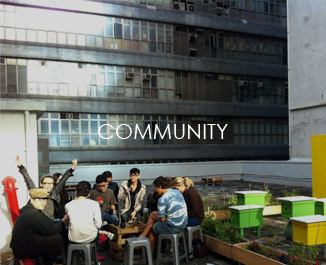
[Image from HK Farm]
–
A. Thesis Title
“SUPERmarket”
B. Thesis Statement
As one of the financial based city, Hong Kong, “Time is Money”. We walk fast, eat fast and think fast.
Sophisticated networks of Supermarkets, Fast Food Stores and 24-hr Convenient Stores are the result in the ultra-high efficiency of Hong Kong. According to the survey from ACNielsen, Hong Kong has the highest percentage of eating fast food in the world, 61% of people eating fast food at least once a week. The high efficiency often leads us to discard nuance of the surrounding. We seldom ponder where the food comes from and how they are produced.
Hong Kong relies on imports for over 95% of its food supply. With the rapid development in Hong Kong, rural farmlands are vanishing. Local supplies of vegetables drop from 81.7% (in 1970) to 1.9% (in 2010). Nevertheless the numbers of urban farms continue to grow and gain its momentum. The total number of both rural and urban farms taking part in a government-run scheme, rises from 123 (2008) to 193 in (2012).
Although space is tight and densely utilized, agricultural activities are seeping their way into urban context. Rooftop farming is an emerging trend in Hong Kong. They can be found in real estates, campus, and also in industrial area, like HK farm in Ngau Tau Kok. Urban farms are the inspiration of this thesis and I am wondering what role of architecture can play in promoting local agricultural activities.
C. Description of Project Intended to Test the Thesis Statement
The concept of the project is to create a “supermarket” in urban scale, which different agri-produces are located in different parts of the city fabric, like different selves in a store. The location of each produce is planned to respond to its particular environmental characteristics, i.e. degree of sunlight, rainfall and humidity. The “supermarket” is aimed to provide a variety of seasonal agri-produces sustainably, like a range of products in a supermarket.
The intention of developing ‘farms” is to advocate slow lifestyle in Hong Kong; to provide a range of agri-produces for local community, which suits its taste; to educate the public and to act as social platform; to recycle urban waste and to improve environmental qualities.
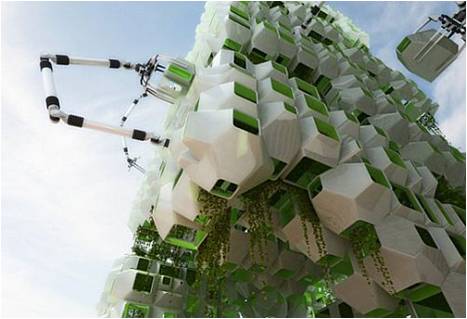
Design of the “farm” is intended to be deployable, expandable and economical. It can be fit in urban leftover spaces, like the back alley, abandoned tunnel, under highway and footbridge, where leftovers are now not leaving behind. Spaces can be utilized by farming, resting and socializing activities. Each “farm” can join with other “farm” to form a matrix, occupying building as a whole. It is made of eco-friendly materials, like bamboo, wood. It is embedded with irrigation and solar systems which can be adjusted in response to different farming conditions, i.e. Less sunlight and water will be needed for a Mushroom farm.
By revealing the production of agri-food, “farm” helps to convert food waste to fertilizer, and with other environmental and social benefits but most importantly it helps our community to address and open dialogue, at least on the issue of the value of food.
D. Outline of Research/ Design Methods
– To understand the existing local rooftop farming culture, to know what to plant and how to operate an urban farmland which techniques can be introduced into the design system.
– To locate and study a site which is potentially favorable for testing out this thesis statement. “De-industrialize” the industrial sites by promoting the urban farming system, is one of the idea.
– To design and test out the deployable structure, which also includes the selection of materials, cost and method of fabrication. The types of vegetation should also under the design consideration.
– To consider the possible urban influences after putting the design into site, therefore to modify the design accordingly, i.e. air movement and urban waste collection.
E. Annotated Bibliography
1) Miazzo, Francesca, Minkjan, Mark. “Farming the city: food as a tool for today’s urbanisation”, Amsterdam : trancity valiz. 2013.
The book compiles various innovative ideas and projects which uses “food as a tool to approach the many challenges inherent in contemporary urban life from a human, locally- oriented perspective”. I am inspired by the approaches and it helps to bring ideas to my project.
2) Mostafavi, Mohsen. “Eocological urbanism”, Harvard University Graduate School of Design, Lars Muller Publishers, 2010
Diverse ideas and understandings of ecological urbanism of practitioners, theorists, economist, engineers, artists, policymakers etc. are learned from this book. It tells the radical approaches between ecology, architecture, landscape and urbanism, which can relate to my project.
F. Supporting Visual Materials
 
 
(TopLeft) Global Map – Urban Agricultural Activities ( by Farming the City): Minimal urban agricultural projects in Asia = High potential for developing the culture?
(TopRight) Rooftop Farming – HK Farm, Ngau Tau Kok, Hong Kong
(BottomLeft) UFU (Urban Farming Unit) by Damien Chivialle
(BottomRight) ECOPODS (Biofuel producing algae) by Höweler + Yoon
|


clear and good . Check out the project http://prinzessinnengarten.net/about/.