Urban Caricature
|
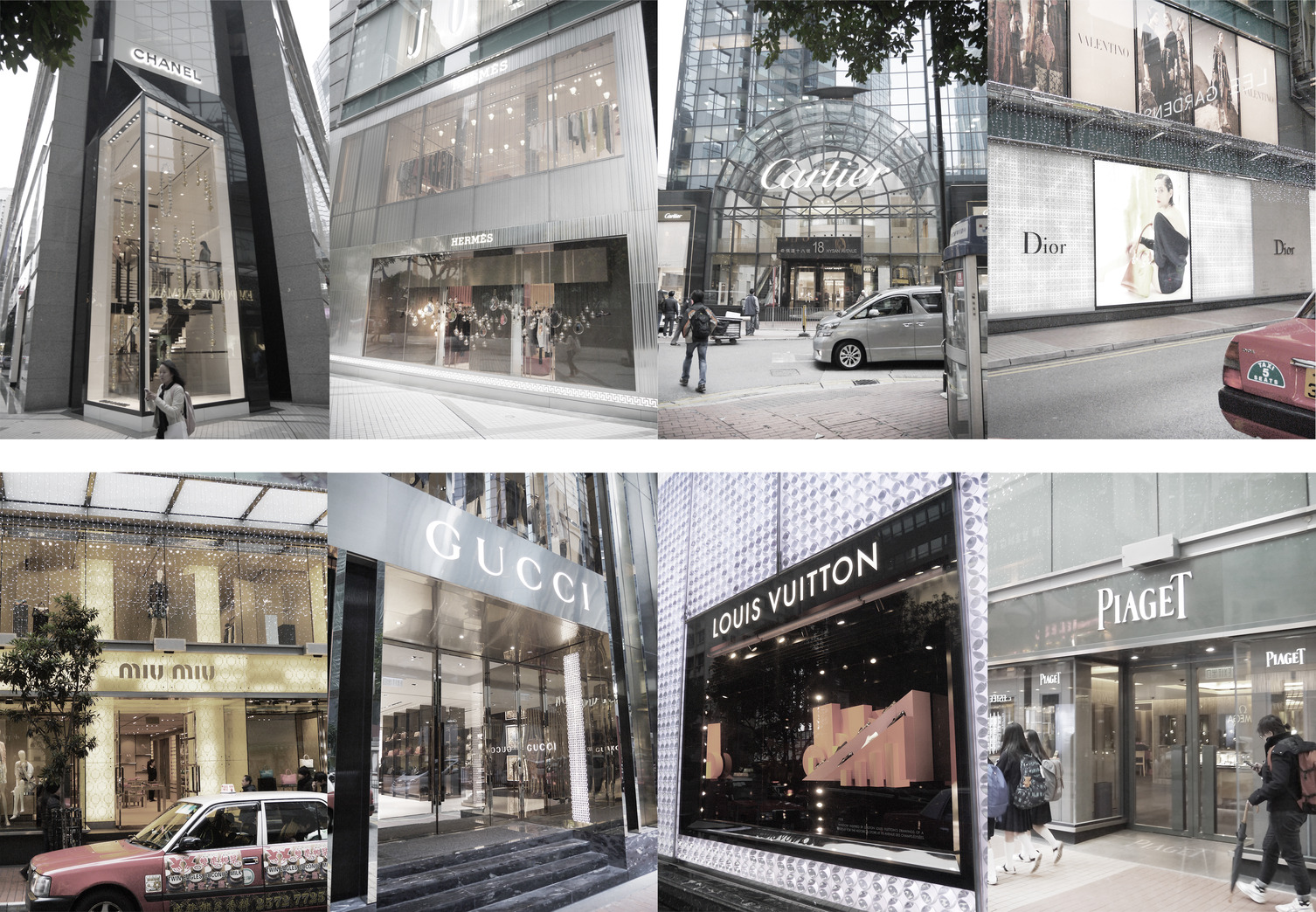
[Suffocated city] In shopping districts of a city like Hong Kong, the city scene largely composed of retail programmes and the related shopping activities. Therefore, when the main group of shopper changes, the city responds and changes as well. In the case of Hong Kong, with the rapid growth of tourism especially since the 2003 Individual Visit Scheme, tourist has dominated over other shopper groups. In 2013, the number of visitor arrivals from major market areas is more than 5 million, and the total tourism expenditure associated to inbound tourism has a growth of 17.6% (HK$160,158.39million). The tourists’ mode of buying is fast, pinpointed, and has a demand on luxurious goods; they are more like buyers than shoppers. Their demand resulted in a huge increase in tourists oriented shops and raised the rent for street level shops significantly that local shops cannot afford. The city is thus transformed into one with a street level singularized by branded shops, filled by tourists and tourists’ activities and become an unbalanced, suffocated place. The excitement for one to ramble along a street for unforeseen encounters is replaced by boringness of expected experience.
[Statement] My thesis aims to respond to this urban phenomenon by opposing the over-domination of the consumerist lifestyle of luxury consumption in the city in a constructive way. The opposite of such lifestyle and programmes shall be (re)introduced into the city to co-exist with and balance it. Since it is difficult to oppose to the economic reality, my architectural response to the current condition is to explore “What Ifs” alternatives for the city in a playful way that act as a caricature to the urban scene. In opposite to the boringness brought by a monotonic street, a fantasy in the city shall be pursued, which to me means the anticipation and imagination of and triggered by the city when one strolls around the city maze that gives surprises and unexpected encounters.
[Fantastical space] A. Precedent examples on the making of fantastical space, in literature/movie:- Alice in the wonderland, which is a famous example of the creation of fantastical world, achieves not only through the characters but also a dramatical spatial journey.
This is an interpretative collage of the story of alice in the wonderland, consists of a maze of multiple choices of routes and loops. Scales and sizes are all indefinite and relative, and common perception of physical construction is revoked.
B. Precedent examples on the making of fantastical space, in realised buildings and existing districts:-
Harajuku in Tokyo is district selling cheap girly goods, in contrast to the other high-end shopping district in Tokyo. It is described as pocketed with rabbit hole boutiques and had a fantastical atmosphere. This is an interpretative collage that represents the district by taking out and exaggerating on the characteristic elements of the district.
[Caricature of Lockhart Road]
This is a collage I made that gives an caricatural impression of the city scene for Lockhart Road (Causeway Bay part), where the unitised compartments are almost like an urban dollhouse in contrast to the lively, messy, down-to-earth city scene on the right.
[Methodology]
At the moment, observed from the research of tenement buildings in shopping districts, that within a block, each building is singled out, like puzzles of the maze side by side each other but all isolated: The first step of the method will be to undo the building: to open up and look for new possibility of arrangement and connection. The buildings will be decomposed layer by layer, e.g.
within each layer, it is further detached to the basic components for re-articulation.
[Programme study]
Upper shop is a response of the city in balancing the current domination of luxury consumption, but the present form of it is too simple and needs re-interpretation:
– programmes are stuffed into rigid compartments like stacked boxes – unfavourable access experience: compartments disconnected from each other As a result, the shopping process of locals are target-oriented, and cannot attain a satisfactory experience of city strolling. My aim is to provide alternatives for this current scene.
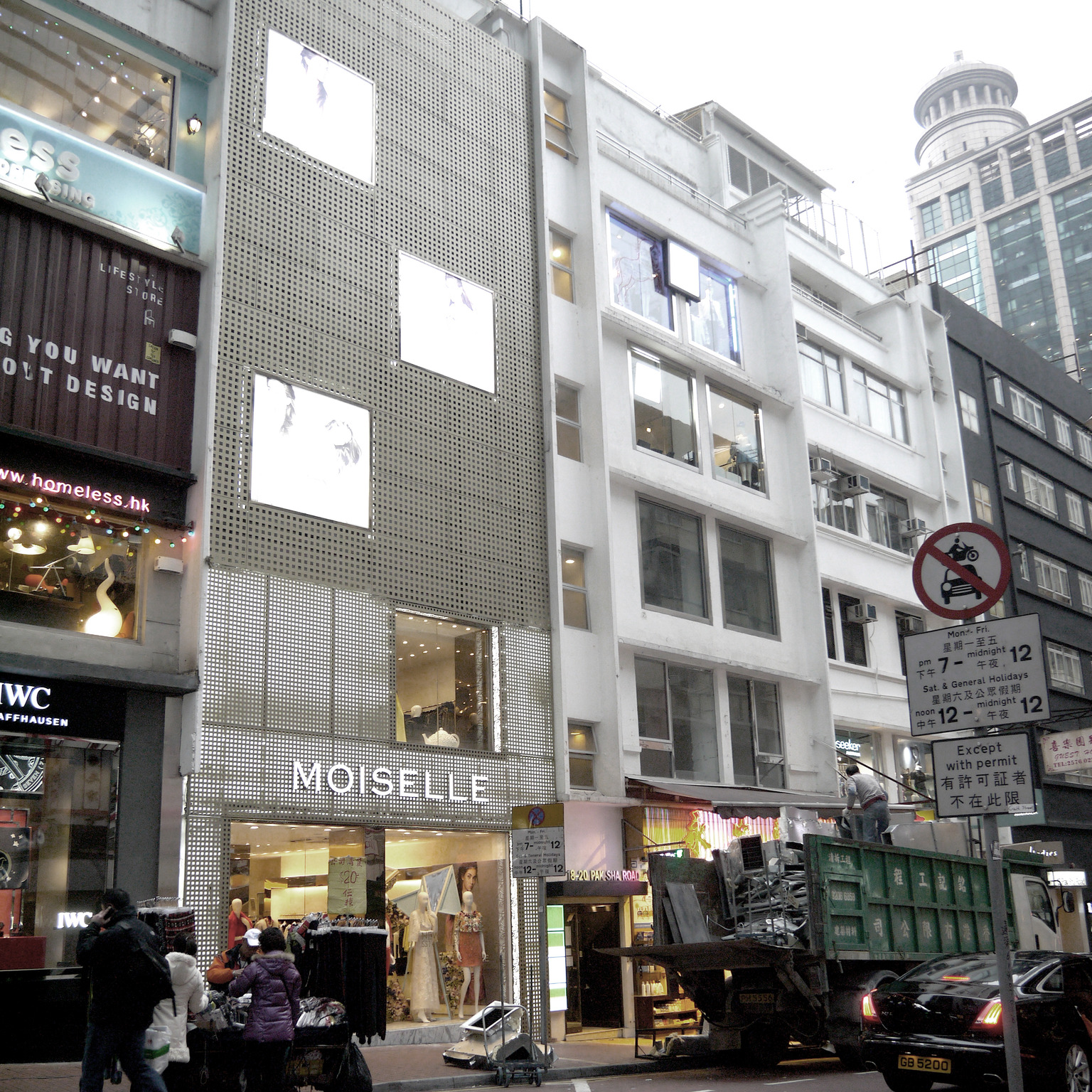
[Site] Pak Sha Road has been chosen as site, because the upper floors of the buildings has a high usage, even till the top floor, and it is in one of the area with densest branded goods shops. Therefore, it gives high potential yet high challenge, and is a symbolic site to work on.
[First review panel]
|