Urban Mirage – Space / Time / Architecture
|
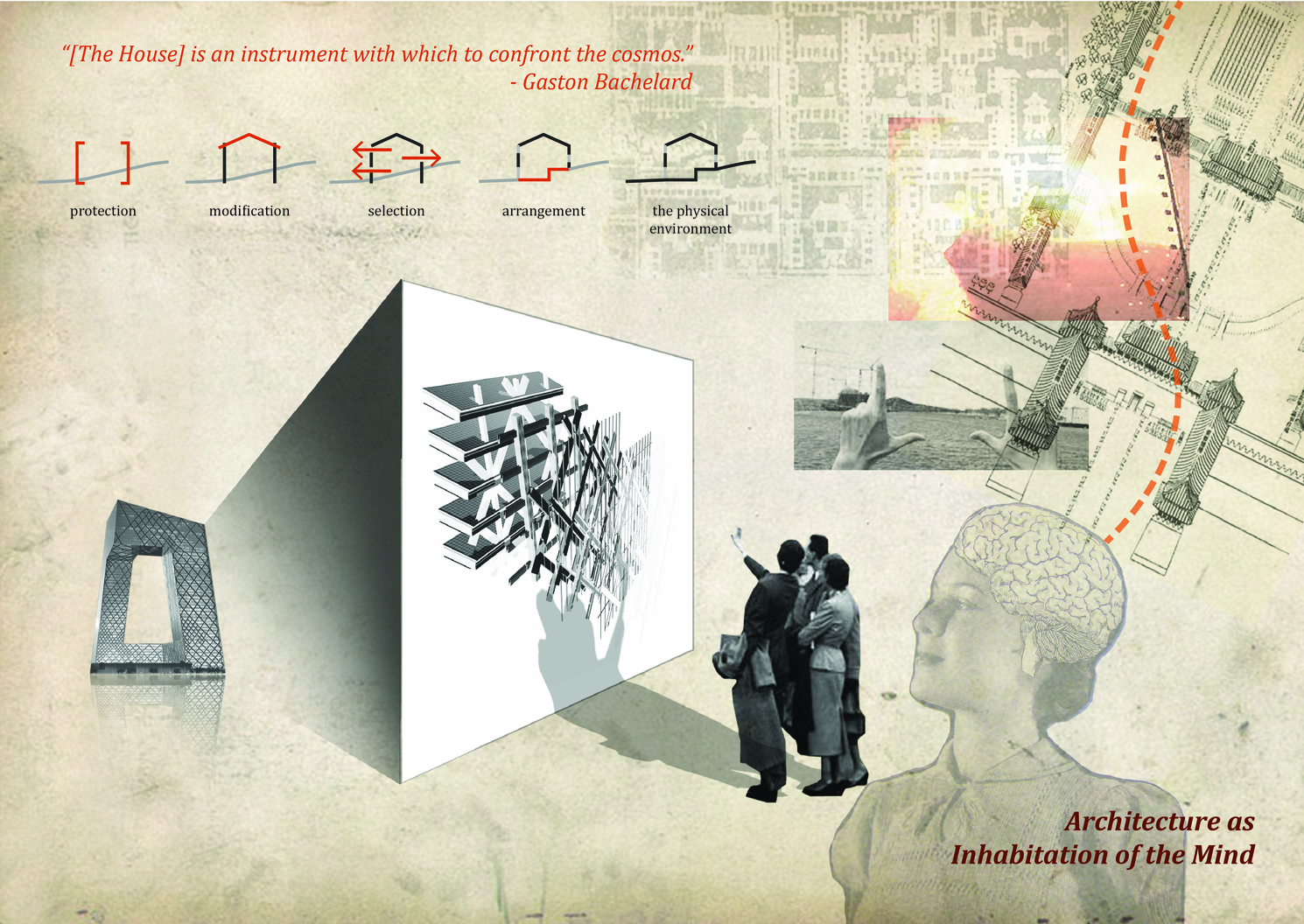
1. Matter / Anti-matter The thesis is first started off by seeing how the architecture is being perceived in today’s world. Nowadays, the task of building is usually seen solely in terms of its functional performance or aesthetic values. Yet, the role of architecture should extend far beyond all these measurable conditions, instead into the mental and experiential part of human mind.
As the French philosopher Gaston Bachelard states: The house is an instrument with which to confront the cosmos. From this, we can understand his metaphor of a house to architecture, is that apart from the physical matter of architecture, the shelter or protection actually contains and inhabits many possibilities. It organizes and structures our experience in which human bodies can take an active role to interpret and modify. Therefore, it brings out another embodied level of architecture which is the anti-matter.
The concept of matter and antimatter, or body and mind, can be illustrated through this project the Tower Infinity in Seoul. The tower is intended to have the ability to “disappear” by using the high tech cameras to acquire the real time image and then process into a monolithic image on the façade to create the invisibility. So we could understand that the meaning of this building goes beyond the object, through the absence of matter, it demonstrates the power of nothingness, since it appears to be the strongest when disappears. 2. Flow/ Flux As a result, the relationship between matter and antimatter is indivisible and mutually linked. The mental dimension of any building is not a mere surplus value to the utility, without this essence, architecture could not reflect the true aspirations and ideas, and become soulless.
But it is sadly that the current city development greatly strengthened the idea of detachment between matter and antimatter. On one hand, the technological advances helped to increase our ability to depict the virtual reality and affected our conception of space. As a result, it trapped us into the objectified or simplified space which we may forget the true experiential essence in architecture. On the other hand, the increased in mobility also affected our conception of time and, in which it demands from individuals and societies the ability to engage in the process of transformation. Due to the social and cultural changes, the function of a space becomes multiple temporalities, going to a museum does not necessarily imply for exhibition purpose, or the elevated walkway is now occupied by different users at different time phases. This informs us that architecture should no longer be a formal static container. 3. Encounter / Cinematic
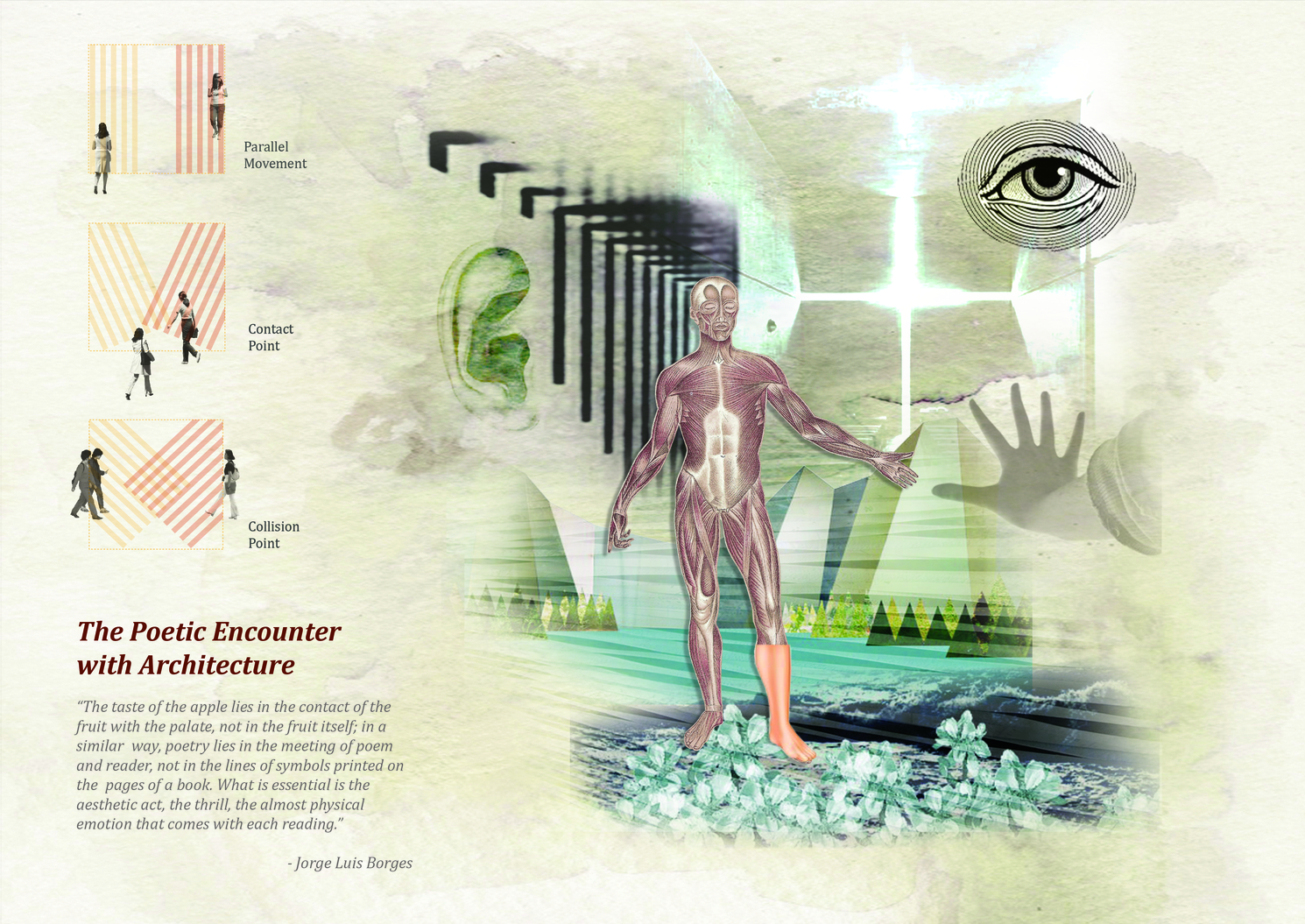
Therefore, the next question for me is how could we reach the mental task of architecture and tie back the bonding between matter and anti-matter? A poet gave an example of what is the essence of the poetry; he said the beauty lies in the meeting of the poem and with the reader, not in the lines of the book alone.
At the same time, the meaning of architecture emerged in the unique encounter of the space and the person. Through creating the scenographic setting, we experience the movement, light or texture; all these formulate the experiential essence of the space and become the extension of our body and mind. As shown in the example of Serpentine Pavilion, the steel structure alone could not truly reflect the idea of the design, only if the person stands at certain angle, together with the external light condition; it creates the ambience that the person could experience the beauty of light, space and geometry. 4. City / Change
To sum up, it is time for us to rethink the architecture in the city, and how could it adapt to the moment of flux and transience. What if the figures of the map are no longer fixed and do not have the solid boundaries, what if the ground could allow flexible flow and penetrate to the buildings? The static matter should be transient to create a series of cinematic stories in the city as informed by the title Urban Mirage. 5. Site / Central
What’s the next will be down to earth to site investigation and explore the possibilities that it could inject to the potential areas.
Comments from critics: – You have to specifically define what is ‘formal static container’ in architecture and give examples, so that you know what are you criticizing at and improve later. – You have to narrow down your themes into a specific research, only from precision you could create variations. – An architecture proposition is needed, you have to relate your themes to the architectural design/ programs
|