Memorial for the Lost-Construction for Destruction
[Statement]Through all the times, human beings are constantly admiring a building which could stand by for thousands and hundreds of years, and endeavor to build something everlasting, which means anti-deconstruction indeed. Actually there is no building in the history could stand forever in fact, there is still another method to be permanent, it is rebirth, as Ise Grand Shrine.
Physically, the Ise Grand Shrine is a series of new constructions every 20 years. However, the building techniques and spirit of the architecture could date back to about It is the belief of the death and renewal of nature and the impermanence of all things — wabi-sabi, and as a way of passing building techniques from one generation to the next. That is the purpose of the rebirth. That is why the construction ceremony is more significant to Japanese than the building itself.
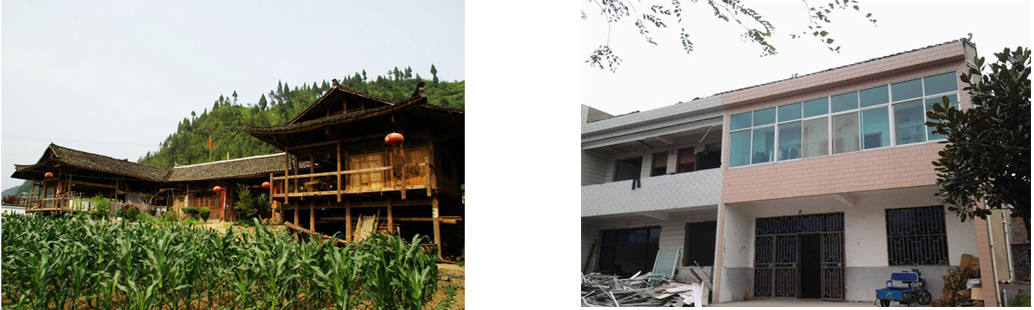
Memorial and Traveling The similarity of memorial between traveling is the purpose- memorial something you do not have currently and traveling to some places you are not there now. They both enable people to experience something surreal, and in the end, people have to go back to the reality. The reality is the inevitability of loss and the generalization of life, as well as the deconstruction of a building. Development and LossThe lost in development is what I want to memorial. In rural area, timber structure stilted houses are replaced by the generic concrete boxes.
In urban area, vividly lanes and houses are replaced by generic towers. Community life at lanes in Shanghai and residential towers in Shanghai. The traditional festivals are abandoned by uniform holidays. Ceremonies at Tujia aborigine village and tourists crowded in Zhangjiajie.
In each of the comparison images, the left one represented as the old that have been lost or losing, and the right one represented as the outcome of development. [Project] The project is aimed at memorial for the lost of the specific culture in an architectural method. Since the loss is inevitable, trying to build a permanent monument does not that make sense. Instead of that, the project is going to design a construction that could be deconstructed and rebuilt systematically and regularly during the memorial event. Site: There are two possible sites could be studied on: 1. There is a minority called Tujia occupied the border area among Hunan, Hubei and Guizhou Province, Mainland China. As their orthodox lifestyle, hosting worship and ceremonies in a high frequency is an essential part of their life. However, the inevitable modernism sweeping all over the world pushed people into concrete boxes and their worship events,which were essential part of daily life, were replaced by ordinary activities as Han people or general urban residents. 2. Even as modern as Shanghai, there are some iconic and specific buildings and space in this metropolis. For example, the lanes space shaped by 3-floors residential houses is a container of abundant community activities. Residents are familiar with each other and diverse interactions take place. Whereas, even those heritages are swept out during this year since the . ProgramBoth of the two possibilities aimed at using the circulation of construction and deconstruction to memorial the loss. 1. For Site 1, in Tujia village, since it is a popular tourism site, the program is going to be a tourist center, which only be built up for predictable big event and be deconstructed during the event, tourists have a chance to interaction with the building and witness its deconstruction in honor of the local civilization. 2. For Site 2, Lane community in Shanghai, the building would provide a community center for residents. Since those lanes and old house will be demolished in a short time, the building will be deconstructed with the community and rebuilt at another community. And the residents will have a chance to dismantle the building by hand. [Methodology] The thesis project will process as the follow: A. Site visit to confirm which site would be proper for the project, B. Study on local traditional architecture, in terms of form, space and material, C. Understand the life style and demand of potential users, D. Develop the technologies in order to get a prototype which could be built efficiently and smoothly, meanwhile be dismantled by hand. Part of the construction material could be recyclable.
[Bibliography] Takaharu & Yui Tezuka: Nostalgic Future, Paul Andreas & Peter Cach Go Hasegawa, Thinking,Making Architecture,Living LU Qun, The original religion culture of Minorities in the district of Western Hunan, ZHANG Ziwei, The votive of Tujia in the district of Western Hunan Tom Mallory,Is Nostalgia Dead? Retro-Futurism, Architecture & Film Baird, George, and Jencks, Charles (editors), Meaning in Architecture |